About Us Board of Directors Contact Us TFF Home Page
TFF Home Page Contact Us Board of Directors About Us Poetry About Cameroon
<td><img src="../sniffer/1_fla2.jpg" width="100" height="133"></td> <td><img src="../sniffer/s1_fla2.jpg" width="200" height="133"></td> <td><img src="../sniffer/a001_fla2.jpg" width="200" height="133"></td> <td><img src="../sniffer/6_fla2.jpg" width="100" height="133"></td>
Search TFF Site:     

 
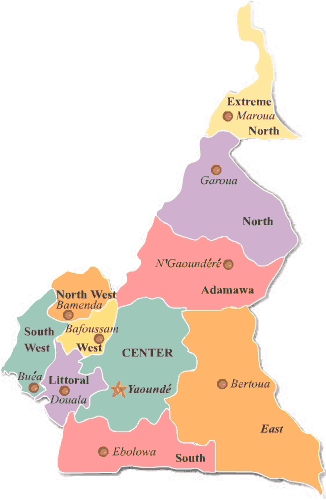
The Republic of Cameroon, approximately the size of the State of California, forms a bridge between western and central Africa. The country shares borders with Nigeria to the West and Chad, the Central African Republic, The Republic of the Congo, Gabon and Equatorial Guinea to the East and South.

Capital City: Yaoundé, (population: approx. - 800,000);

Main commercial Centers: Douala (population: 1.2 million - approx.) Other important cities: Bafoussam, Bamenda, Buea, Garoua, Kumba, Limbe, Maroua and Nkongsamba

Official Languages: French and English

Population: 14 million (est. – 1997)

  • Women 51 percent
  • Men 49 percent
  • 60 percent of the population is under the age of 19
  • Urban population: 46 percent

Literacy Rate: 63 percent

  • Women 52 percent
  • Men 75 percent

Economic Facts

  • Approximately 60 percent of Cameroonians are employed in the agricultural sector.

  • Agriculture, including forestry and fishing, accounts for 41 percent of the GDP and employs an estimated 63 percent of the labor force.

  • While GDP increased between three and five percent from 1997 to 1999, this follows a decade of poor economic performance spurred by the decline in the world prices of Cameroon's major exports. The economic policies of the government also contributed to Cameroon's economic difficulties, including bad loans by government-controlled banks that caused many of the banks to close and inefficient public enterprises to go bankrupt. Transparency International has twice (in both 1998 and 1999) declared Cameroon the most corrupt country of 87 polled around the world.

  • Privatization of the country's 120 public enterprises has been slow, half-hearted and less than transparent. The Cameroon Government still holds public monopolies of the petroleum, energy, water, telecommunications, aluminum and cotton industries; and owns the national airline, shipping line, and an investment fund.

  • An agreement with Chad for the construction and operation of an oil pipeline was signed in 1995; however, construction has not yet begun and some investors privately worry about the Cameroon Government's ability to meet its obligations. In a recently published open letter to The World Bank. 86 international non-governmental organizations highlighted the concerns expressed by civil society organizations in both Chad and Cameroon about the preparation of the project due to "the lack of accountability to affected populations, lack of transparency and absence of the rule of law."

  • Cameroon's main export products include coffee, tea, cocoa, spices, timber, textile, petroleum and palm oil.

  • Cameroon's major exports include industrial and transportation equipment, food and beverages, energy and lubricants.

 
   State of Democracy       TFF in the News        Related Activities       Poetry