|
Cameroon: Genuine and Inclusive Dialogue Only Way Out Of
Ambazonia Quagmire - Apartheid Chief Negotiator Roelf Meyer
May, 2022
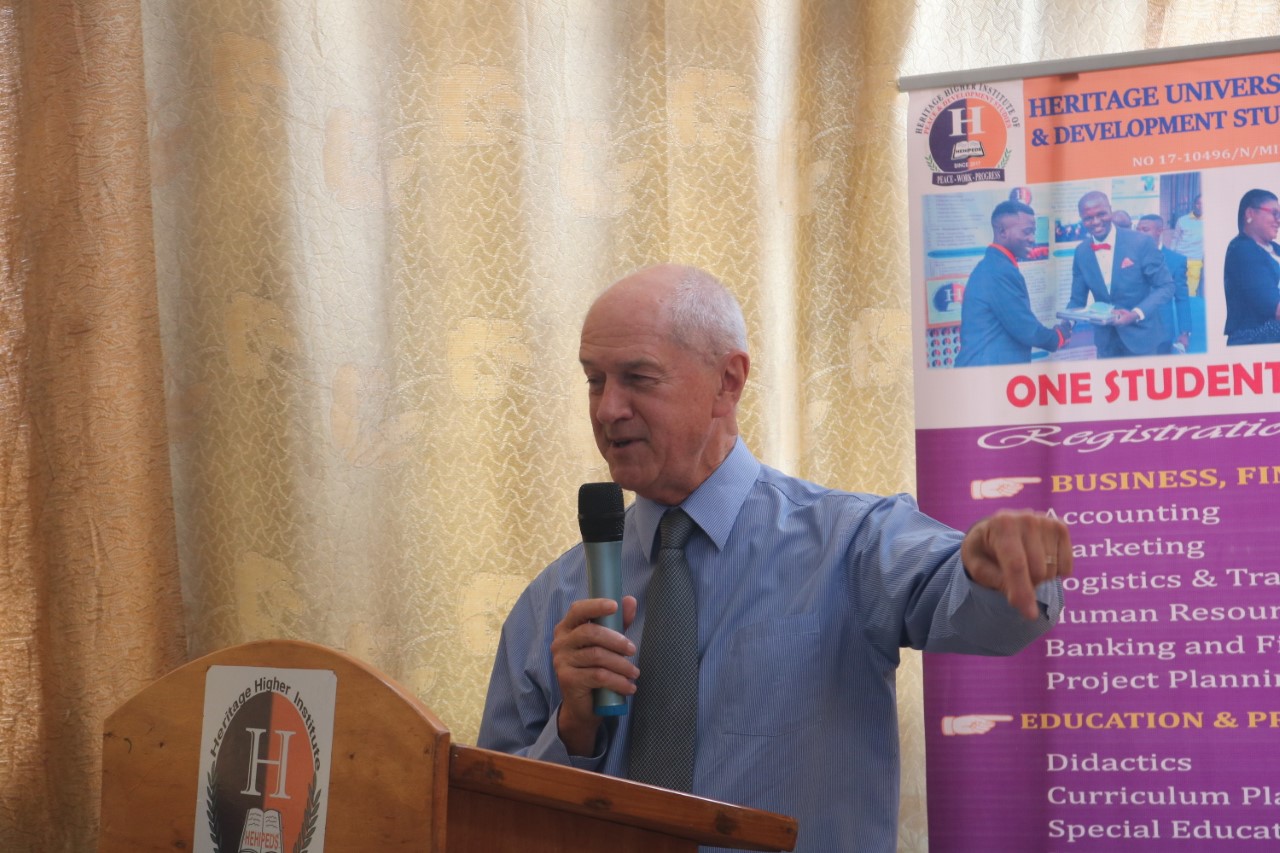 People in Cameroon are suffering and paying a price when there is a
solution, says former South African Cabinet minister Roelf Meyer
People in Cameroon are suffering and paying a price when there is a
solution, says former South African Cabinet minister Roelf Meyer
When it comes to issues of peace and conflict resolution in Africa, Roelf Meyer
is a revered figure in his own right. As lead negotiator with current South
African President Cyril Ramaphosa in the late 80s and early 90s, a new dawn was
ushered in for South Africa following successful talks that led to the end of
the nefarious apartheid system.
The ongoing crisis in the English-speaking regions of Cameroon are largely
surmountable but the government needs to prioritize genuine and inclusive
dialogue as a matter of urgency, says Roelf Meyer. Interviewed after a recent
visit to Cameroon, Meyer says it was shocking how little the outside world seems
to understand the depths of the crisis in the North West and South West Regions.
The callous killings are unnecessary Meyer says as he urges the international
community do more in helping to push for peace and a lasting solution to the
crisis.
"We are, based on the South African experience, big advocates for dialogue as the
real instrument to bring about change and to resolve conflict and I would say
for the case of Cameroon, that is what is required," says Roelf Meyer. Meyer
whose peace initiatives now span the globe believes that there are many lessons
from the South African experience that could serve Cameroon.
You visited Cameroon in April, your first visit to that country in which
an armed conflict currently pits the Cameroon government against non-state
armed groups in the North West and South West Regions, formerly known as
British Southern Cameroons. Is this a sign that you and your organisation
are interested in contributing to end that conflict?
Roelf Meyer: In 2013, I co-founded In Transformation Initiative
in South Africa to share our South African experience with people and countries
in conflict situations around the world. We have been very successful in many
countries because of interest in the South African experience of how we changed
insurmountable conflict, especially in the late 1980s, into a situation where we
could make a peaceful transition from a dictatorial state to a democratic state.
In fact, we have shared that experience in several countries around the globe
including on the African continent, and recently I was asked by a well-respected
Cameroonian to take interest in the conflict in the country. Thus, in April, I
had the privilege of visiting Cameroon for the first time; it was a brief visit
that lasted a few days in Yaounde and Douala. The main purpose was to speak
about peace building and development in two academic institutions.
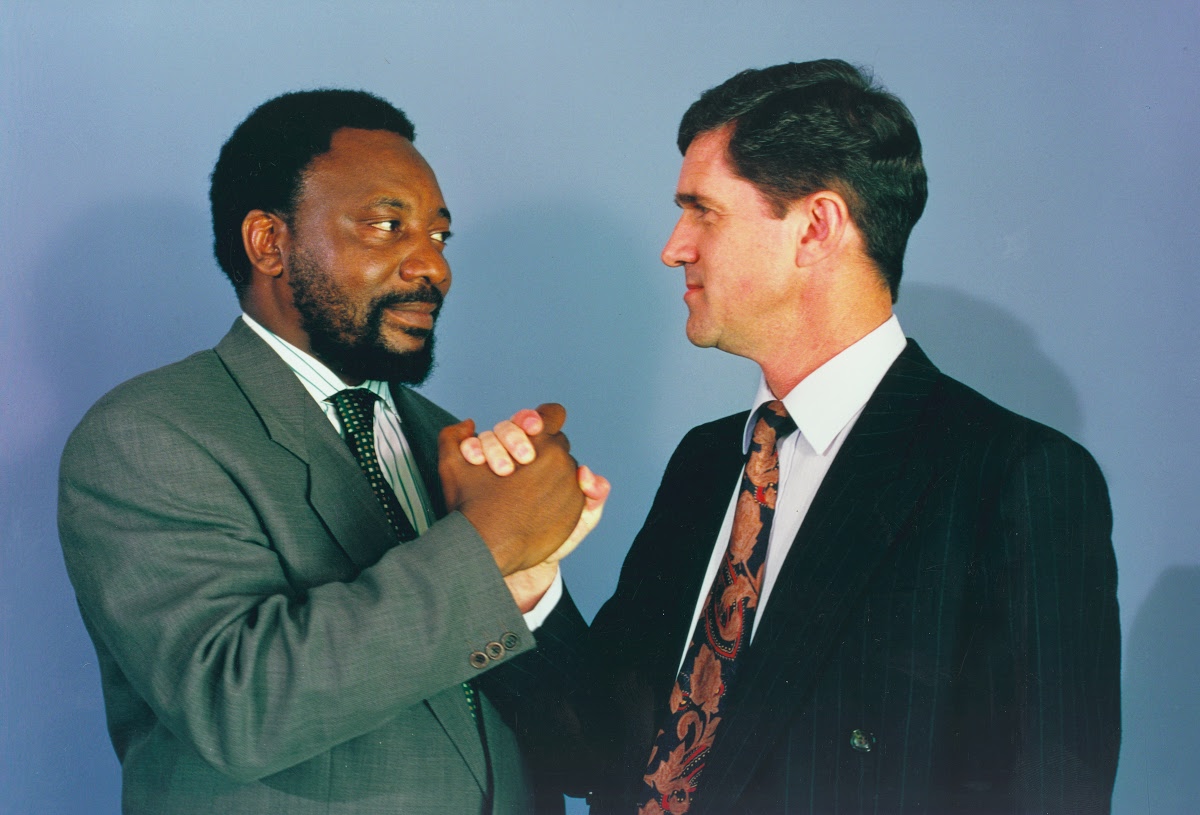 Current South African President Cyril Ramaphosa and Roelf Meyer were key
actors in the process that ushered in a new South Africa, there are plenty
of lessons that could help Cameroon from that experience ,says Meyer
Current South African President Cyril Ramaphosa and Roelf Meyer were key
actors in the process that ushered in a new South Africa, there are plenty
of lessons that could help Cameroon from that experience ,says Meyer
Although this was your first visit to Cameroon, were you able to take the
pulse on the conflict beyond your speaking engagements in the two academic
institutions?
Roelf Meyer: I had the opportunity while in Yaoundé and
Douala to speak to individuals who have close knowledge of the conflict in
Cameroon. I received a broader understanding of the conflict and what is going
wrong. One thing that struck me was the level of violence that prevails and
unfortunately is not known to the outside world. I think it is important that
the international community take note of what is happening there to try and
support a process that will bring the violence to an end. The unnecessary
killing of people, mostly civilians, who have been drawn into the conflict is
unnecessary and unacceptable. I also tried to get a better understanding of the
underlying factors behind the current bloodshed and unnecessary violent
conflict. You may remember that we experienced enormous political violence in
South Africa before the release of President Nelson Mandela from prison in 1990,
and even after his release. Listening to various individuals in-between the
speaking engagements, I and my fellow Director of In Transformation Initiative,
Mr Junior John, both left Cameroon feeling we could perhaps draw on our South
African and other experiences on our continent and globally to help resolve the
conflict, but we will have to see how the situation unfolds.
Given your contribution as lead negotiator with current South African
President Cyril Ramaphosa for the release of Nelson Mandela and the end of
apartheid in your country, do you believe Cameroonians could draw any
lessons from the South African experience?
Roelf Meyer: I think Cameroonians could draw from the lessons
that we learned from the South African case. Surely, each conflict has its
characteristics and has to be respected for its uniqueness, but certain basic
principles do however apply across country specificities. For example, we
succeeded in South Africa to build a wholly inclusive peace
process; all relevant parties that were part of the conflict participated in the
dialogue and eventual negotiation that led to a peaceful transition from
apartheid to democracy. The second was that we succeeded in building
trust across the divide that existed. For example, President Cyril
Ramaphosa was the chief negotiator for the African National Congress (ANC), the
leading anti-apartheid movement, and I was privileged to be the chief negotiator
for the government of President De Klerk; and the two of us succeeded in
building a bridge between us first of all ? we developed trust between us which
was hugely instrumental in resolving the South African conflict. The third
factor is the fact that we succeeded in taking responsibility and
ownership of the problem that we had to resolve. We accepted that
it was our conflict and we accepted that we had the responsibility to resolve
it. It was a mutual commitment from the opposing sides to indeed contribute to
resolving the conflict such that we also accepted mutual responsibility for the
outcome.
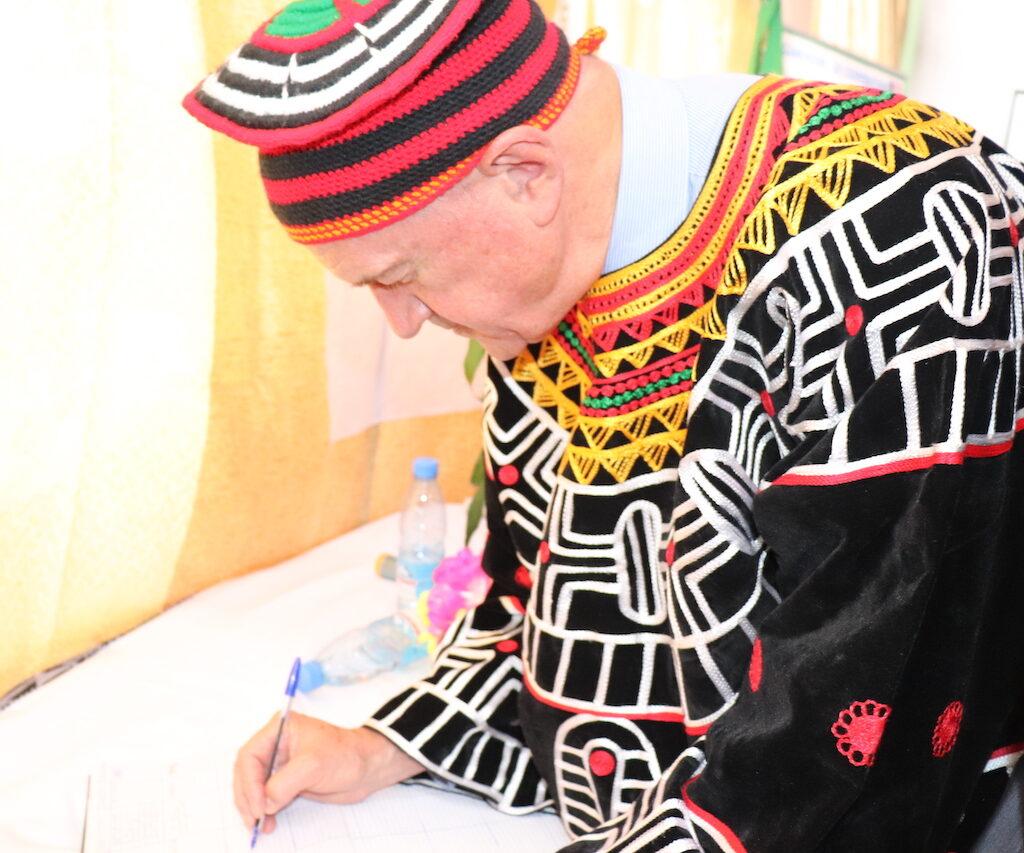 The callous killings are unnecessary Meyer says ,as he urges the
international community do more in helping to push for peace and a lasting
solution to the conflict
The callous killings are unnecessary Meyer says ,as he urges the
international community do more in helping to push for peace and a lasting
solution to the conflict
You were also Minister of Constitutional Affairs, first under President
Frederick De Klerk and later under President Nelson Mandela; so would you
say certain constitutional models are more amenable to guarantee peace,
social justice and human dignity, and prevent conflict? What would be the
main characteristics of such constitutional arrangements in a country like
Cameroon with a very diverse history and culture, and now going through an
armed conflict because of those same factors?
Roelf Meyer: The three factors I mentioned above are all key in
helping to resolve the conflict in Cameroon. In the South African case, for
example, the one thing that fundamentally helped us to resolve the South African
differences was that we accepted that the future South Africa that we had to
create had to be built on accepting individual rights on an equal basis for all,
to ensure that blacks and whites could live together as equal individuals in a
future South Africa. That was the fundamental factor that contributed; we did
not see ourselves as the black majority and white minority but as equal
individuals, and that foundation is in the constitution that we have today which
was negotiated between the opposing parties. That constitution was also the main
contributing factor to find a settlement in our conflict and help us to
transition from an authoritarian regime like apartheid was to a democratic
government which we have had in South Africa since 1994.
Based on your experience in South Africa and engagements in many conflict
resolution initiatives around the world, and on your preliminary
conversations thus far, how do you think the ongoing conflict in the North
West and South West regions or what some people refer to as former British
Southern Cameroons or Ambazonia can be resolved?
Roelf Meyer: Yes, I think it is possible to draw from other
experiences including that of South Africa in addressing the Anglophone conflict
in Cameroon. In my mind, the starting point of the resolution of any conflict is
to establish the basis for talks. It often starts with 'talks about talks', then
the real talks, and then you get to a situation of dialogue which flows into
negotiations that address the situation and root causes. If this method can be
followed in the case of Cameroon, it is most likely that the starting point is
there but also a possible path to an acceptable outcome. Time is also of the
essence, and there's urgency in stopping the bloodshed and further alienation.
AM: Having been Minister of Defence earlier in your career, when you
compare the situation you had to grapple with within South Africa, and what
obtains in Cameroon today, what are some of the similarities that you see
and how challenging can it be to get a solution that meets the expectation
of conflicting parties?
Roelf Meyer: In terms of my experience as Minister of Defence,
let me emphasize that I was Minister of Defence after the dialogue and
negotiations already started in South Africa - my task as Minister of Defence
was therefore to lead the process of negotiations within the military so as to
address the issue of integration in the military and the paramilitary of the
liberation movements. That process was started during my tenure as Minister of
Defence and from that experience, I can say some similarities need to be
addressed although there are also unique features of the Cameroonian conflict in
that regard. In the South African experience, we deployed a very strong military
response to uphold the powers of the minority white regime in South Africa, but
this too had to be addressed during the negotiations. We successfully integrated
the different military and institutional forces but also the paramilitary from
the liberation movements. And the day that Nelson Mandela was sworn in as the
first democratically elected president of South Africa, by his side was the
chief of the military of the former apartheid regime which shows how effective
that process of integration and successful transition took place in the South
African case.
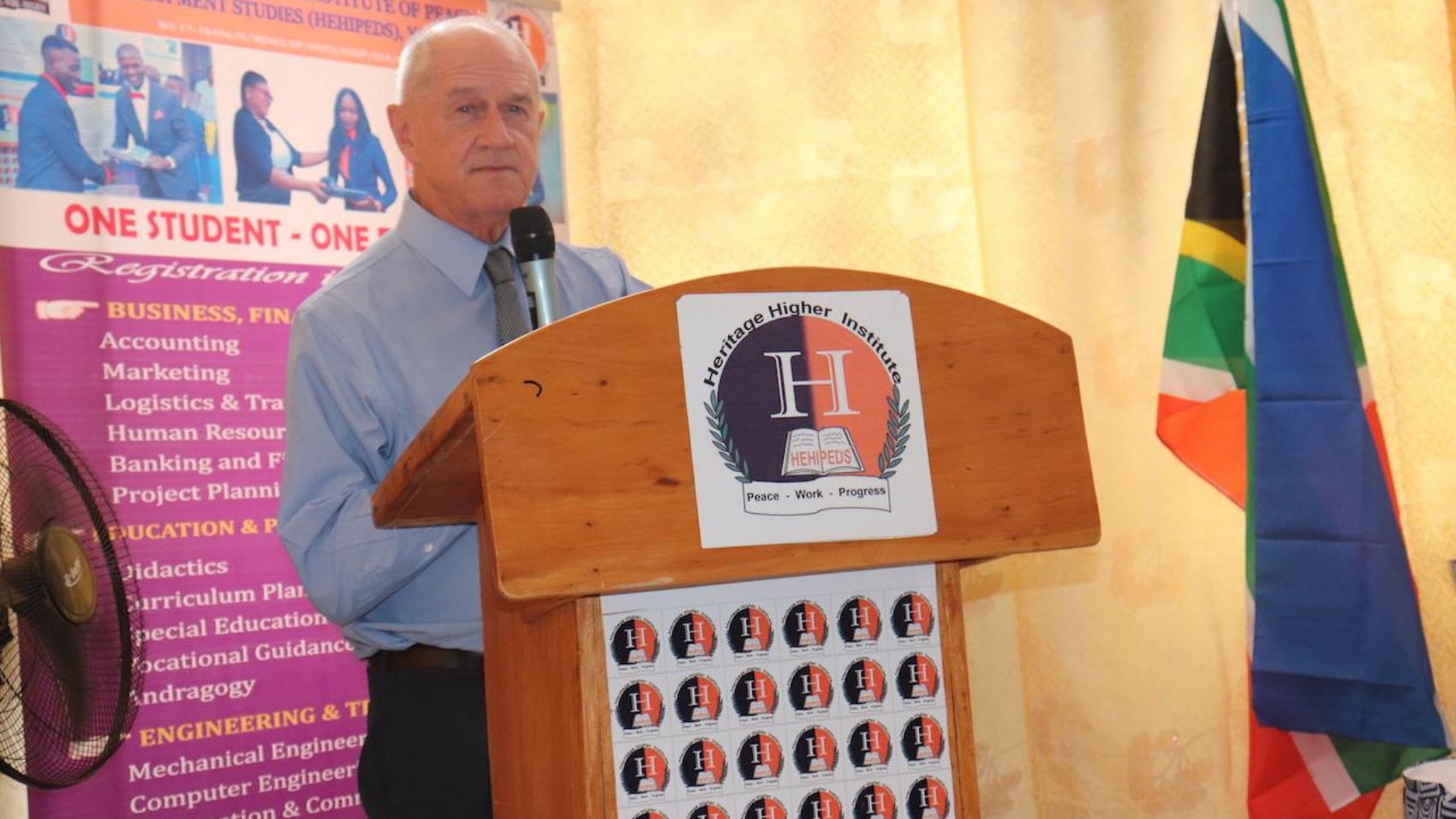 Watching the situation from the outside, it seems to me that the conflict
in Cameroon is not insurmountable in terms of seeking a solution, says Roelf
Meyer
Watching the situation from the outside, it seems to me that the conflict
in Cameroon is not insurmountable in terms of seeking a solution, says Roelf
Meyer
In a conflict of this nature where there has been so much bloodshed,
distrust, pain and suffering, divergent views, fragmented groups, vested
interests for some actors on both sides and so many other complexities, what
would typically be a starting point for addressing the root causes and what
other logical steps would follow suit?
Roelf Meyer: In my view, the only real solution to the crisis is
genuine, inclusive dialogue, and I can say that from the South African case that
was our experience. We are, based on the South African experience, big advocates
for dialogue as the real instrument to bring about change and to resolve
conflict and I would say for the case of Cameroon, that is what is required.
Looking at starting points, it often has to start with discrete talks meaning
below the radar; only a few people may know about efforts to test the water and
laying the foundation before actually getting into it. That is what happened in
the South African case with some talks taking place between the apartheid
government and Nelson Mandela while he was still in prison and the same with the
exiled leaders of the liberation movements. There were 'talks about talks' even
three or four years before the actual process started after the release of
President Mandela. Maybe that is something that can help us to address the
situation in Cameroon. I understand that some of that may already have occurred
in diverse forms - the process of talks that could lead to better understanding,
preparing the ground with confidence building measures, testing the waters and
then eventually delving into dialogue and negotiations to reach mutually
acceptable positions for the opposing sides. Watching the situation from the
outside, it seems to me that the conflict in Cameroon is not insurmountable in
terms of seeking a solution, and one has to address the complexities mentioned
one by one and then the result and solution will follow.
With your very rich personal and professional experience, should you and
South Africa, which remains a giant on the continent, be called upon to help
seek a lasting solution to the conflict in Cameroon; would you and the
country consider that possibility?
Roelf Meyer: It is early for me to say whether South Africa or
myself can play a role. I think it depends on how things evolve within the next
several weeks or few months. I don't think it is opportune now to say outright
'yes' to the question. We must keep in mind that South Africa is a
non-interested player as far as the sub region is concerned. South Africa has
not been directly impacted by the conflict in Cameroon and that is, I think,
quite a neutral, objective, and independent posture as far as the conflict is
concerned. For that reason, it could play a constructive role which also
describes my own position if I were to take further interest in helping the
situation in Cameroon. For now, I would like to wish the people of Cameroon well
in their endeavour to find solutions to the conflict. Like I said, one of the
most important lessons from the South African experience is that we took
ownership and responsibility and, yes, some advisers and people shared their
experiences with us but in the end, we internalised the fact that it was our
conflict in South Africa and that we had to resolve it through negotiations, and
that is exactly what we did.
panafricanvisions.com
Dr. Christopher Fomunyoh
Président, The Fomunyoh Foundation
christopher.fomunyoh@tffcam.org
www.tffcam.org
|