|
DR CHRISTOPHER FOMUNYOH:
From Guzang to Washington, Anglophone
Cameroon's Finest Export
June, 2021
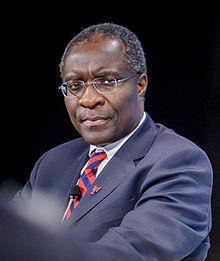
Dr Christopher Fomunyoh (born 14 August 1956) is the Senior Associate for Africa and Regional
Director at the National Democratic Institute for International Affairs. The first son of coffee
farmers in his native village of Guzang – Batibo subdivision, Fomunyoh attended Christian
primary education institutions in Guzang, Ambo, and Eka-Bifang, then went on to the Cameroon
Protestant College, Bali for secondary school studies, graduating in 1973. He later attended the
Cameroon College of Arts, Science and Technology, Bambili and obtained the General Certificate of
Education Advanced levels in 1975, before proceeding to then University of YaoundÊ, Faculty of
Law and Economics.
Academia
Fomunyoh holds a License en Droit from the University of YaoundÊ, 1979; an LL.M. in
International Law from Harvard Law School, 1989; and a Ph.D. in Political Science from Boston
University, 1993. He also holds a professional certificate in Air Law from the UniversitÊ Paul
CÊzanne Aix-Marseille III. Dr. Fomunyoh is an adjunct faculty at the African Center for
Strategic Studies, and a former adjunct professor of African Politics & Government at Georgetown
University. He is perfectly articulate in both French and English
Career
Upon graduation from University of YaoundÊ, he worked for the Water Corporation, SocietÊ
Nationale des Eaux du Cameroun (SNEC) and later for Cameroon Airlines both in the coastal city of
Douala where he established and managed the Legal department for more than six years before
departing Cameroon to pursue further studies at Harvard University. Shortly after graduating from
Harvard, Fomunyoh served on internships with the Law Offices of the Bank of Boston (USA), and
Standard Chartered Bank in Douala, Cameroon. In 1993, he joined the National Democratic Institute as
senior program officer. Today, as senior associate and regional director at NDI, Fomunyoh has
organized and advised international election observation missions, designed and supervised country
specific democracy support programs in partnership with civic organizations, political parties and
legislative bodies across Africa. In the course of his work, Fomunyoh interacts regularly with heads
of state and government, cabinet ministers, elected officials, political and civic leaders. He
recently designed and helped launch the African Statesmen Initiative a program aimed at facilitating
political transitions in Africa by encouraging former democratic Heads of State to stay engaged in
humanitarian issues, conflict mediation, public health and other key sectors of political economic
and human development on the continent. As an authority on democratization in Africa, Fomunyoh is
highly solicited by news organizations and makes frequent guest appearances on major mainstream
media including Cable News Network, British Broadcasting Corporation, National Public Radio, Voice
Of America, Radio France Internationale and Radio Deustche Welle. He provides interviews for print
news organizations such as the Los Angeles Times, The New York Times, The Washington Post,
Washington Times, Le Monde and 'International Herald Tribune. In one of his multiple media outings,
Fomunyoh considered colonial rule as "...a terrible moment in African history and for the world
too...", but he also places culpability for Africa's current problems on what he unambiguously
terms "...bad governance and lack of visionary leadership..." Fomunyoh upholds the supremacy of the
constitution and strongly objects to distortions of the document to suit personal or sectional
whims. He points to the Ghanaian example as schemata for budding democracies. Chris Fomunyoh
recently remarked:
It is extremely important to frequently renew political
leadership in every country so new leaders can bring a fresh perspective to global trends and
developments, and help move their countries in ways that may differ from previously long held
typical and traditional approaches.
Civic Advocacy
Through his life, work and pronouncements, Christopher Fomunyoh espouses respectful communication
even amongst disagreeing parties – the kind of dialogue that reaches for compromise by
considering the views of all parties involved through 'yesable' proposals. Fomunyoh
remembers putting this practice to use in the mid-1970s, as one of the executives and founding
members of the UNESCO Club at the University of YaoundÊ; and before that, in his activist days
as a student leader and president of the Moghamo Students Association from 1975 to 1979.
Fomunyoh's Foundation Radio, in Bamenda Cameroon vigorously upholds the creed of 'Giving
Voice to the Voiceless' and strives to provide a platform for airing the concerns of the
silent/impoverished majority and the establishment of the right contacts for obtaining much-needed
skills for self-reliance. His family foundation TFF, partners with various traditional civic and
administrative institutions within Cameroon to foster these goals. That has earned him encomiums
among various Cameroonian constituencies such as: the Sawa Women of Bonendale, Douala in the
Littoral region, some of whose cultural and development projects the Fomunyoh Foundation has
supported; the Moghamo Women Empowerment Center in Batibo; and the chieftaincy in Dschang in the
Western Region where Fomunyoh holds the honorific traditional title of 'Suffo'.
In the months leading to the 2004 presidential elections in Cameroon, Fomunyoh’s name was touted by
various interest groups, parties and independent observers as a potential candidate for the race. A
few years before the 2011 presidential contest, speculation was rife in the Cameroonian media of
both French and English expression, the blogosphere and the Cameroonian Diaspora about the
possibility of a Fomunyoh vs Biya show-down. While many Cameroonians pondered the possibility of
holding credible, free and fair elections when the election administration body – ELECAM
– was perceived as partisan, they also sax 2011, as likely to be an epoch-making poll.
Fomunyoh has not dropped a traceable hint about his immediate plans; yet a lot seems to be submerged
in the unsaid. His comments to the media have been a blend of nostalgia for some aspects of the
country of his teenage years and an unflappable optimism for better years ahead and the
possibilities and potential for positive and meaningful change for Cameroon and Africa as a whole.
Growing calls for Fomunyoh to jump into the political fray in Cameroon represent a variety of things
to a variety of people: Cameroonian democrats need a boost to their advocacy efforts in favor of
good and accountable governance given the government's performance; while Cameroonians in the
Diaspora would love to see someone at the helm of the State that could use his/her international
stature to regain credibility for the country and its reputation on the world stage.
Strong Case for Southern Cameroons
Dr Fomunyoh has been very vocal when it comes to crisis rocking the Anglophone regions of Cameroon.
Speaking as a witness in the Canadian House of Common's Subcommittee on International Human
Rights of the Standing Committee on Foreign Affairs and International Development, Fomonyuh went
back to the root causes of the five-year-old armed conflict blaming majority French Cameroon
government for aggravating it by bad faith efforts to assimilate Anglophone minority into
Francophone majority.
He expressed three main worries namely: government's inclination to use military and brute
force to resolve legitimate political grievances of Anglophones, continuous poisoning of minds
because of killings and atrocities perpetrated in former British Southern Cameroons, lukewarm
attitude of international community beyond a few declarations and now resolution 684 of US Senate.
He argued that Canada is in a unique position to contribute to an end to the armed conflict that
addresses root causes, mutually respectful relationship across Africa and with European countries
that it could leverage and galvanise to help end the conflict.
Dr Fomunyoh has repeatedly advocated for immediate ceasefire and cessation of hostilities and
public commitment by the government of Cameroon and non-state actors to negotiations with
third-party facilitation. Use good offices to engage France to leverage position to get the
government commit to peace negotiation to bring an end to and address root causes. Adopt targeted
sanctions against perpetrators of torture and other atrocities.
Many observers, however, say the root cause of the ongoing crisis has yet to be fully addressed and
that is why the violence persists. This can only be solved if the root cause of the crisis is
addressed through a meaningful dialogue by both parties.
"I have said so myself. Until we get down to the root causes of the conflict, we are not going to
solve it. We have to have the courage and address the grievances and until we do that the rest is
just sugar-coating, speeches about a sense of normalcy that is not there. This is unacceptable and
we need to address that," says Dr Fomunyoh.
With the call for an end to the violence coming from within and from international bodies, the
Regional Director says inviting the leaders of these groups and sitting down in a room using a
neutral platform with help from mediators may just be the key to bringing an end to the crisis.
The Anglophone crisis, he says, has gone past the level at which decrees from a government minister
can handle. According to him, the crisis is more than one government can handle and drive it to its
logical end. If the present situation continuous, it would be terrible, he notes.
"If the government comes on the table with representatives of these armed groups and that both
delegations come out with a joint communiquÊ saying from henceforth no gun shall be fired in
the North West or South West Regions, that kind of joint approach is likely to pay dividend than
what we have seen thus far," Dr Christopher Fomunyoh reiterates.
|