|
Blinken lays out U.S. policy toward Africa and deliberately
avoids mentioning China
November, 2021
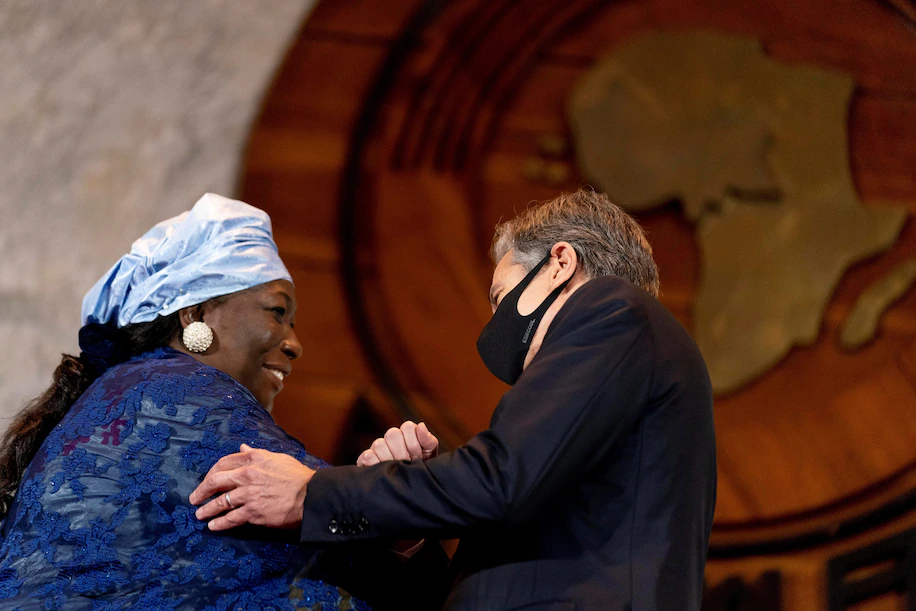 Finda Koroma, vice president of the Economic Community of West African
States, greets Secretary of State Antony Blinken as he takes the podium to
give a speech Friday in Abuja, Nigeria, on U.S. policy toward Africa.
(Andrew Harnik/Pool/via Reuters)
Finda Koroma, vice president of the Economic Community of West African
States, greets Secretary of State Antony Blinken as he takes the podium to
give a speech Friday in Abuja, Nigeria, on U.S. policy toward Africa.
(Andrew Harnik/Pool/via Reuters)
ABUJA, Nigeria - Secretary of State Antony Blinken on Friday gave the Biden
administration's first speech articulating its Africa policy and refrained from
mentioning the most consequential economic player on the continent: China.
The omission was no mistake.
Blinken and his top aides view the past four years of U.S.-Africa policy under
President Donald Trump as ham-handed and focused on forcing African leaders to
choose between working with the United States or China in a Cold War-style
standoff.
Blinken made clear, in his first official visit to Africa's most-populous
country, that Washington wanted to partner with African countries because it is
mutually beneficial rather than a proxy battle to limit Beijing's influence.
"I want to be clear: the United States doesn't want to limit your partnerships
with other countries. We want to make your partnerships with us even stronger.
We don't want to make you choose. We want to give you choices," Blinken told an
audience at the headquarters of the Economic Community of West African States, a
regional economic union based in Abuja, the capital of Nigeria.
The approach is a significant shift from Trump, whose top diplomat, Mike Pompeo,
often railed against Chinese-led infrastructure projects as "debt traps" during
his three-country trip to Africa in 2020 and criticized telecom projects in
Africa by the Chinese firm Huawei.
Trump himself had a strained relationship with the continent, inviting criticism
with his reference to the nonexistent African nation of "Nambia," and broad
generalizations about African states as "shithole countries." His travel ban on
several Muslim-majority countries, including some in Africa, inflamed relations
with important security partners such as Chad and forced the administration to
remove it from the list so as not to jeopardize operations against the extremist
group Boko Haram.
In its first 10 months, the Biden administration has sought to reset Washington's
relationship with the continent, providing more than 50 million doses of
coronavirus vaccines to 43 African countries and announcing a variety of
financial investments in health, education and climate adaptation projects in
Africa.
"I know I'm hardly the first U.S. secretary of state to come to Africa and
promise different and better engagement," Blinken said. "I also know that many
countries across the region are wary of the strings that come with more
engagement, and fear that in a world of sharper rivalries among major powers,
countries will be forced to choose."
Though Blinken's approach is different, analysts say merely jettisoning a style
that many African leaders viewed as lecturing and condescending will not be
enough.
"It is not just that Blinken has learned that Africans didn't appreciate having
U.S. engagement in Africa framed as some sort of great power competition with
China, it is also a recognition that like it or not, the Chinese and many others
are a real presence on the continent and that in many respects the U.S. is
playing catch up," said Cameron Hudson, an Africa expert at the Atlantic
Council.
"It's hard to be preachy when our involvement in so many areas is only episodic
and surface level," he added.
China's involvement in Africa has exploded in recent years, going from a
relatively modest player in the 1990s to becoming Africa's largest trading
partner. By 2019, one in five African infrastructure projects was financed by
Beijing and one in three was being built by it.
The trend has alarmed U.S. lawmakers, and experts in Washington have urged the
United States to aggressively counter Chinese inroads on the continent.
African leaders and some analysts have countered that Africa's infrastructure
needs are great and rejecting Beijing's offers would be political and economic
malpractice.
In a news conference on Thursday, the foreign minister of Nigeria, which has
taken on billions of dollars in debt from China for infrastructure projects
including roads, rail and gas pipelines, rejected criticism of the joint
ventures.
"We saw a great opportunity with the Chinese," Foreign Affairs Minister Geoffrey
Onyeama said. "They are used to a lot of these huge capital projects and
infrastructure projects."
"We would have gone with anybody providing something at a competitive rate," he
added.
Blinken, when asked about Chinese investments during the news conference, avoided
characterizing working with the United States or China as a binary choice.
"When it comes to infrastructure investment, again, this is not about China or
anyone else, it is about what we would like to think of as a race to the top
when it comes to those investments," he said.
He said investment from China into the continent was good in principle but warned
that African countries should not be saddled with "tremendous debt that they
cannot repay," and noted that workers' rights and environmental standards
shouldn't be overlooked.
Defenders of the Trump administration's approach say that its campaign against
Chinese infrastructure projects raised awareness about Beijing's practices in a
way that continues to benefit U.S. and African policymakers.
"In many respects, Secretary Blinken does not need to raise the issue because
Secretary Pompeo and others raised it and, by doing so, gave the impetus of U.S.
attention, both public and private, to questions of transparency and
sustainability of deals and especially of the debt involved," said Peter Pham,
Trump's former special envoy for the Sahel region of Africa.
Pham noted the controversy within the Democratic Republic of the Congo over a
$6.2 billion minerals-for-infrastructure project that has come under growing
domestic scrutiny, including calls to renegotiate it. "The conversation [over
Chinese projects] has been taken up with vigor by Africans themselves," Pham
said.
Christopher Fomunyoh, an Africa expert at the National Democratic Institute, said
American infrastructure projects need to succeed on the merits, rather than
through rhetorical sloganeering. "You can't browbeat people into denying the
precariousness of their development; rather, an approach that brings them to
embrace and value the strength, quality and durability of the American public
and private sectors is a winner," he said.
panafricanvisions.com
Dr. Christopher Fomunyoh
Président, The Fomunyoh Foundation
christopher.fomunyoh@tffcam.org
www.tffcam.org
|