|
Cameroon Communication Council: Peter Essoka as the new
'Strongman'
December 11, 2014
By Prof. Asonganyi
When trouble broke out in the past between News Media/Journalists and the
National Communication Council (NCC), I wrote two articles. One was titled
"Joseph Befe Ateba: Journalist on the Other Side" in which I stated as follows:
"The mission of outfits like the government-controlled NCC is to check the power
of the press, and by implication, society's freedoms, to cede space for
government power�Some apologists may say that there are other journalists in NCC
other than its Chairman. Of course, they are there, but most seem to at least
cover-up by indulging in sophistry and casuistry. Whatever the case, it is Befe
Ateba that is in the dock. After all, it is usually said that the buck can be
passed on but it must end somewhere. For the NCC, the buck ends with Joseph Befe
Ateba�"
In a second article titled "Mocking The Rule Of Law By Lynching Figuratively And
In Essence" I stated as follows: "The rule of law abhors interferences like the
'fifteen-days-renewable' of administrators, suspension of journalists and news
outlets by the NCC, and many other niches carved out by government for appointed
officials to wield discretionary power � a subversion of judicial authority by
executive power! Indeed, such government appointees virtually always work
actively or passively to diminish the rule of law�.Those with thin skins should
not leave the impression in the public mind that the press in Cameroon fought a
gallant fight against censorship in the 1990s and censorship ended up having the
last laugh..."
Things have since changed � not for the better! Following his unfortunate demise,
Joseph Befe Ateba's role is being played by ... a seasoned journalist! And so
the buck now ends at the feet of the new strongman. That man that stands accused
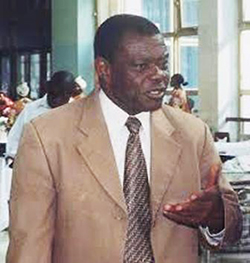
following the recent highhandedness of the NCC is called Peter Essoka.
Since the '60s, we have been grappling with governance based on constitutionalism
that is said to separate state power into three arms: the executive, the
judiciary, and the legislature. If this form were to be respected, laws would be
made by the legislative arm, interpretation of laws and adjudication would be
the role of the judiciary, and execution of laws would be the role of the
executive arm. Our ideological differences may separate us on substantive issues
of governance, but at least, there did not have to be any quarrel on procedural
issues related to this set up.
Unfortunately, in Cameroon, the executive has always exercised overbearing power,
dabbling in issues supposed to be reserved for the judiciary, and giving the
right of interpretation of laws and adjudication to administrative officials
(DOs, SDOs, Governors) and to outfits like the NCC. And so, since independence,
we have lived in an environment made oppressive by blind, incompetent,
self-serving elite constituted into a cabal that is stuck with old, long
discarded paradigms, oiled by impunity and an obsession for corruption and theft
of the common wealth.
These people pretend to be oblivious of the reasons for which Africa and Africans
are the laughingstock of the world. They pretend not to know that the oppressive
environment they create clogs our minds, and does not leave room for our
indulging in the work and life of the mind that give birth to the glittering
material culture that is all around us in this fast evolving 21st century. They
pretend not to know that if the African mind has to function at the level of the
minds of those who create these glittering things that we indulge in to
facilitate our lives on earth, our oppressive environment has to be lifted and
replaced with the type of environment that those other minds live in. They
pretend not to know that those freedoms we all sing about are the pillars of
this environment in which the sovereign individual or the citizen as �the legal
subject,' is at the centre of law and judicial due process. The human genome
project has since given its verdict: overall differences in performance of human
communities are not due to nature (genes) but to nurture (environment). We
should always remember what Kennedy said to the American people: our goal is not
peace at the expense of freedom but both peace and freedom. Whatever we do, we
should always remember that freedom is the key to unlocking the creative spirit
of society in all domains. Our man who is promising emergence in 2035, and
hurrying another obnoxious, so-called "anti-terrorism" bill to the national
assembly to make our environment even more oppressive, should take note of this.
It is interesting that these people of the NCC use what they call "dispassionate,
fair, accurate and balanced" reporting to punish journalists. A prominent
politician in Nigeria once declared that "if the next elections are rigged
Nigeria will be made ungovernable." Nigerian journalists were divided into two
camps (and more!) with one saying that the politician was sounding a warning
against vote-rigging, while the other was saying that the politician was
threatening to cause confusion in the country if he didn't win. The mind of an
actor like the politician in question is a domain opaque to examination and
difficult to assess. How one can measure "dispassionate, fair, accurate and
balanced" here is difficult to say in real life, although they will tell you
they are taught in journalism school how to do so.
This is just a simple example of the type of information and news in society that
must be dealt with by journalists. It is also to say that truthful or falsehood,
whether an idea, principle, value or view is valid or not, depends on changing
times and changing peoples of varied orientation, minds and motives. Journalists
are usually condemned to deal most of the time with a part, not the totality of
an experience. They usually are forced to deal with the way things appear, not
the way they are or can become. What each journalist usually ends up with
depends on the entreaties of their reason and passion, of logic and experience,
of their scale of values, of their intelligence. This is why they rarely ever
reach definitive judgment. In the heat of the robust debate that journalism
entails, journalists usually enjoy even a democratic right of error.
A person like Mendo Ze was general manager of CRTV from 1988 to 2005. Nine years
after his leaving CRTV, he was recently arrested as a suspect of malpractices
during his tenure in CRTV! After all those years, in spite of the audit report
that had since made him a suspect! What would Peter Essoka and his NCC court say
would be "dispassionate, fair, accurate and balanced" reporting about this
former CRTV big-man while the executive labored with prosecuting him at its
whim? Perhaps journalists should look the other way until the executive decides
to act when they like, as if they are running a private estate! A truth is
unchanged by the fact that it is not known or that it is known only by a few.
We also hear that our high priests of the NCC say journalists are guilty of
"insulting" an official of the presidency! It seems that they do not also count
the misfortunes of Cameroon in Kondengui prison as we all do. If they did, they
would know that those high places are home to a cabal with insatiable appetite,
which has replaced the general interest with self-interest, and needs to be
permanently watched by the press. When we battled for the creation of
"independent" structures to regulate the activities of society, we were not
bargaining for kangaroo courts like the NCC. We understood "independent" to mean
what it has always meant: non-attachment to any branch of government or
alignment to any political interest; non-promotion of the narrow interests of
any political party, or sectional group. Who doubts who is paying the piper?
With this sorry performance of the NCC, Paul Biya can now rub his hands in glee
and ask us: you say I abuse the overwhelming power I have because I am a bad
leader. See what they are doing with the little fraction of my power I gave to
them.
And what would be our response, apart from seeking the answer to Geoffrey
Chaucer's question in General Prologue to his Canterbury Tales: if gold rust,
what then will iron do?
Well, let me borrow the signature of one of my friends to put my own question:
Peter Essoka, are we together? If we are, then answer Chaucer!
|