|
Dr. Christopher Fomunyoh: President of Cameroon
?
Dr. Christopher Fomunyoh, Regional Director at the Washington based
National Democratic Institute, NDI and President of the Fomunyoh
Foundation, was presented by the Cameroonian media as a serious
challenger to incumbent President Paul Biya for the 2011 presidential
elections. But he ended up not declaring his candidature. This
speculation has again resurfaced; this time around in the form of a book
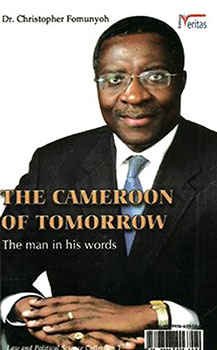
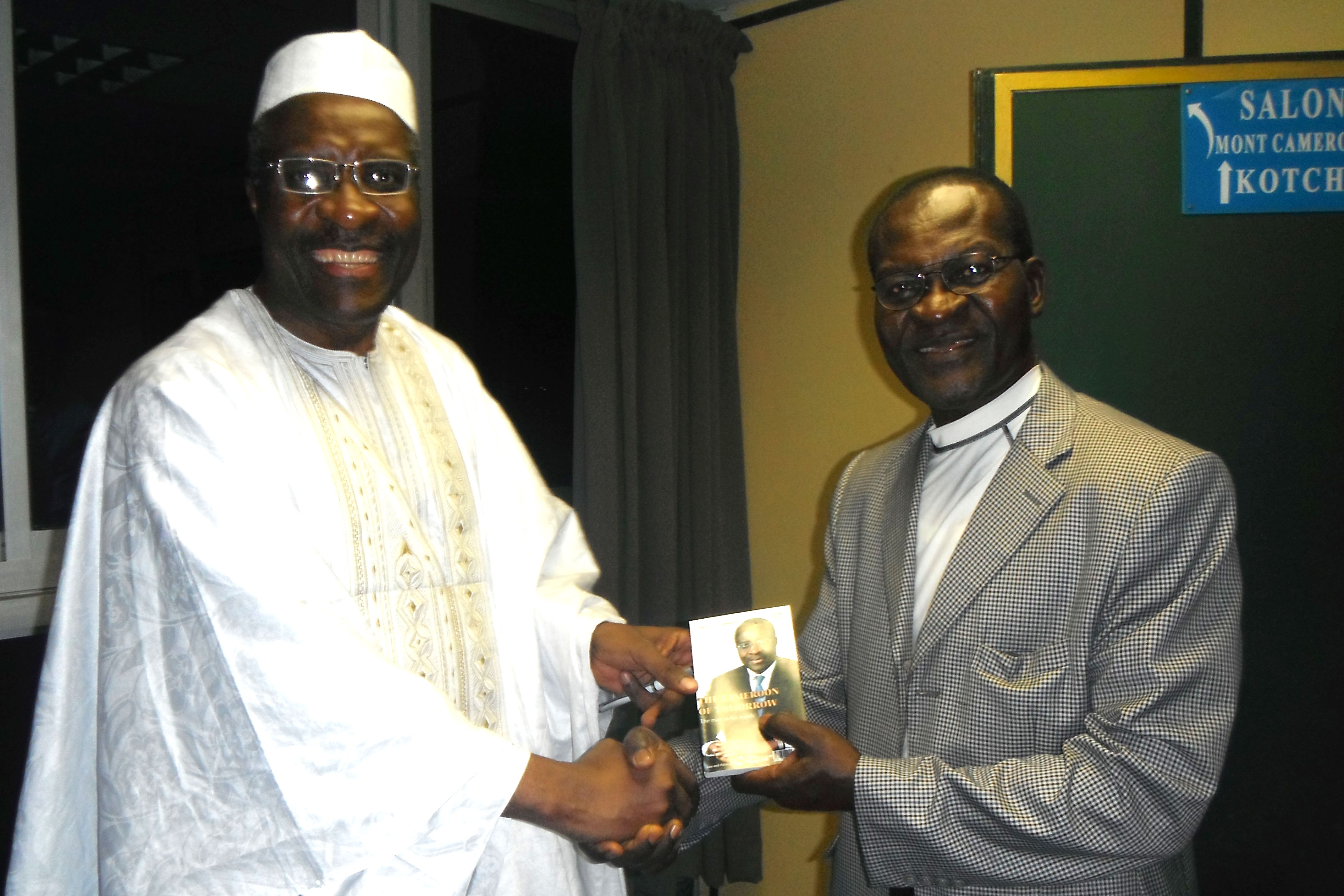
"THE CAMEROON OF TOMORROW"
The strong positions Dr. Christopher Fomunyoh has been taking on the undemocratic
practices in Cameroon and human rights violations perpetrated by the ruling
regime and his experience in election monitoring singled him out as the one
person who could emerge as consensus candidate for the opposition at the time.
His consultation in Cameroon with political forces during his sabbatical in the
run-up to the 2011 presidential were interpreted as lobbying to be single
candidate, but that was not to be.
At a time when the debate is already revolving around President Biya's succession
in Cameroon, the name of this fine expert has again cropped up in the form of a
book.
In his book titled "Dr. Christopher Fomunyoh - THE CAMEROON OF TOMORROW;
The Man in his words", Mokun Njouny Nelson, a practicing
journalist, apparently presents the manifesto of an ideal candidate standing an
election, which in all intents and purposes refers to Dr. Christopher Fomunyoh
who has not yet declared for any party, nor created one.
The book which was launched in Douala, Cameroon's economic capital on Saturday
September 13, 2014, does not state clearly whether Dr. Fomunyoh is nursing
presidential ambitions. Answering a question to this jigsaw during the launch,
he was categorical; > "With the experience and expertise that I have
gathered over the years, I will not spare any time and effort to be part
of the efforts of the Cameroonian people towards a more democratic and
economically viable Cameroon."
The book also espouses the views of Christopher Fomunyoh on the Anglophone
problem, the Biya regime, elections, the rule of law and democracy. It paints
the portrait of an ideal presidential candidate and suggests ten points on which
the opposition in Cameroon can work to attract national and international appeal
and visibility.
The book THE CAMEROON OF TOMORROW is bilingual in English and
French.
Nwan Tangwi
READ FOREWORD BY PROF. TAZOACHA ASONGANYI BELOW
This is a book about Dr. Christopher Fomunyoh, a well-known name in Africa on the
issues of democracy, and democratic elections. He is sometimes described as �
Mr. Africa � of democracy and free and fair elections. Although he is an expert
and authority on democracy in Africa, he does not impose his ideas on other
people; he espouses respectful communication even among disagreeing parties to
reach consensus and compromise. This is a great strength of leadership because
leaders have to build consensus around their convictions and reconcile them with
the personal convictions of others. He is always aware that it is such "balance"
among disagreeing parties - factions - that gives democracy its built-in
self-control.
Dr. Fomunyoh has watched events unfold in Cameroon from his privileged position
at the Washington DC-based National Democratic Institute, NDI. He has had the
foresight to imagine the best future for Cameroon and point the way to it,
as so aptly summarized in this little book about him.
He has not only pointed the way to the future, he has tried to imagine how we
can get there - reason for his interest in visionary leadership, and � a fresh
face untainted by the fatigue and scandals of the ruling party or fragmented
politics of the opposition�.
Consequently, in the build-up to the 2004 presidential election, Dr. Fomunyoh's
name was mentioned as a possible candidate; the same was true for the 2011
presidential election. He confirmed himself that he was � determined to stand
side by side with [his] fellow compatriots come this October (2011). � However,
the absence of a level playing field dissuaded him from being one of dozens of
candidates that finally participated and lost woefully to the incumbent Paul
Biya who had undemocratically prepared the ground for his own victory.
In all that he has written and said, Dr. Fomunyoh has been making considerable
effort to furnish the glue to hold people together, and the imagination around
which people can mobilize to bring change to our society. He is always aware
that the change we all dream of is too complicated, too multifaceted - too human
- to be arranged in linear logic from cause to effect. The seed of change is in
all of us; for the seed to sprout, it needs just a change of attitude by those
who have failed us before; just the casting away of their selfish attitudes;
just their coming together to make something different, something that has not
happened before, happen. The type of future we are all dreaming of is neither a
straight line projection of the past, nor the present; there can be a better
outcome than would be got by adding up past experiences; the past is just
prologue, not a forecast. Those who are leaders of big, medium and small
parties, as they are usually described in the divisive opposition ranks had
better pay attention to this vision of Dr. Fomunyoh.
In politics it is impossible to acquire a mastery over ends, over the choice of
the means to achieve the ends, and even over one's own self. Politics cannot be
redefined simply by an act of will that anyone can undertake at any time; The
perceptions that guided the plebiscite that was conducted in British Southern
Cameroons on February 11, 1961 should be viewed within this perspective. By the
time Southern Cameroons went to
the polls for the plebiscite, the longest Dr. Emmanuel Endeley lasted as Premier
was three years; the longest John Ngu Foncha had lasted was three years. At that
time, it was unimaginable that the democracy we sought would allow Ahmadou
Ahidjo to remain president for 23 years; and his successor would last for 30
years or more! It was also unimaginable that there could be a one-party state.
It was unimaginable that the country's name, "Republic of Cameroon" which
Southern Cameroons united/reunited with, would be brought back years later to
represent the name of the united country. In a way, following the plebiscite,
there was a one-sided affirmation by nationalists of the "Republic of Cameroun"
- the denial of the need to preserve the political place that had to make
society's self-interrogation and self-critique possible.
In each society, the distinction between the political and politics creates the
space in which democracy becomes possible. The political is the way in which a
society and its members come to understand themselves; it is the process by
which a society expresses its autonomy, giving itself its own laws; it is the
condition of the possibility of politics.
The political binds the citizens into an autonomous community that endures,
evolves over time, and generates responses to new challenges. The generation of
such responses could involve processes that lead to successive radicalization of
reflection on who citizens or a subset of citizens are and what kind of society
they want. It could also involve a series of particular resistances usually
transformed from a stubborn negation of arbitrariness into a normative political
affirmation of a solidarity for which no sacrifice was too great. This can be
said to be the present state of the Anglophone in Cameroon today. This changing
political nature and the closing of the public space in which self-
interrogation and self-critique of society had to occur brought with them new
questions and new challenges.
It is usually odds that prop up on the road of human evolution that define the
human spirit. The human spirit is very powerful, indomitable, and is capable of
achieving any aim it sets itself. This is why in human history new beginnings
are always possible. New beginnings are possible because political action in
society is usually divided into periods, described as "lived experience,"
"reflection" on lived experience, and "conception" of new action or new
beginnings. The "new" action always constitutes the first stage of the next
political "period." Ahidjo may have messed up the unification agenda; his
turpitudes may have been legitimized/legalized with the problematic and
provocative change of name of Cameroon back to "Republic of Cameroon" using law
N� 84-1 of February 4, 1984.
These are all issues in the public place that need to be addressed, barring the
regular abuse of the human rights of SCNC militants who advocate secession,
following Paul Biya's secessionist law N�84-1.
Dr. Fomunyoh is right to state that: "Ironically those that govern Cameroon
today seem to think that turning a blind eye or using tough-fisted tactics would
resolve the grievances of Anglophones. They should think again and especially
note that tensions have been exacerbated with each passing year... I am looking
forward to a day when there would be a genuine discussion on how to resolve the
Anglophone problem in a way that can make each and every Cameroonian feel part
and parcel of this country..." He advises that Anglophones should know that in
Cameroon, they have the "right to have the cake and the knife and decide the
distribution..."
Of course, this can only become possible if the space between the political and
politics in which democracy becomes possible returns to our democratic
landscape, giving birth to conditions for the organization of truly free and
fair elections in
Cameroon. This little book "The Cameroon of Tomorrow" is testimony to the fact
that Dr. Christopher Fomunyoh is doing everything to use all the experience he
has gathered on elections and democracy over the past decades, to make this
happen in Cameroon.
Yaounde, September 20, 2012.
Prof. Tazoacha Asonganyi
Faculty of Medical & Health Sciences,
University of Yaounde I
Former Secretary-General of the Social Democratic Front (SDF).
|