|
Change Is Bound To Occur In Cameroon � Dr. Christopher
Fomunyoh
ICICEMAC
April 05, 2012
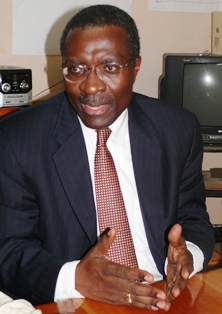 There are a lot of smiles in Senegal and across Africa for what most people say
were free, fair and credible elections. Except for the attempt at tinkering with
the constitution to give out-gone Abdoulaye Wade a third mandate.
Dr. Christopher Fomunyoh, who is currently Senior Associate and Regional
Director for Central and West Africa at the US-based National Democratic
Institute, NDI, says the Senegalese Presidential election was among the best,
most transparent and credible elections witnessed across the African continent.
In this exclusive interview with The Post, he maintains that, for a peaceful
transition to occur in Cameroon, Government should develop the political will
and respect for citizens in order to create the appropriate framework and
mechanisms for credible democratic elections to take place. He argues that, with
just a little focus and commitment to democratic governance, Cameroonians, too,
could renew their political leadership, peacefully, through the ballot box.
Excerpts:
There are a lot of smiles in Senegal and across Africa for what most people say
were free, fair and credible elections. Except for the attempt at tinkering with
the constitution to give out-gone Abdoulaye Wade a third mandate.
Dr. Christopher Fomunyoh, who is currently Senior Associate and Regional
Director for Central and West Africa at the US-based National Democratic
Institute, NDI, says the Senegalese Presidential election was among the best,
most transparent and credible elections witnessed across the African continent.
In this exclusive interview with The Post, he maintains that, for a peaceful
transition to occur in Cameroon, Government should develop the political will
and respect for citizens in order to create the appropriate framework and
mechanisms for credible democratic elections to take place. He argues that, with
just a little focus and commitment to democratic governance, Cameroonians, too,
could renew their political leadership, peacefully, through the ballot box.
Excerpts:
The Post: You've observed elections on the continent for a long time. How
do you assess the last presidential elections in SenegalT?
Chris Fomunyoh: These presidential elections in Senegal are among the best, most
transparent and credible elections I have witnessed across our continent of
Africa. The Senegalese people should be very proud of themselves and their
democracy. They have also given democrats across this continent, especially the
African youth, reasons to be proud and hopeful about the future, and so they
deserve our collective applause and appreciation. After a series of flawed or
fraudulent elections, the continent needed a real boost and a happy success
story to show that we Africans can conduct peaceful and credible elections just
as is the case in established democracies on other continents.
What impressed you most?
First, the Senegalese youth and civil society organisations were the first to
reject outright and forcefully, attempts by outgoing 85-year-old President
Abdoulaye Wade to extend his stay in power. It was their courage and extensive
mobilization across the entire country that emboldened the political parties and
the electorate in general to realise that the stakes were extremely high for the
country and the elections were worth fighting for. Besides public demonstrations
in Dakar, civil society groups also recruited, trained and deployed thousands of
observers to monitor the elections in the country's 12.000 polling sites. These
citizen monitors also harmonised their actions through a common platform, with
one of coalitions undertaking parallel vote tabulation (PVT) to fasten the
transmission and analysis of data and information by SMS mobile phones in order
to crosscheck the veracity of official election results. The Senegalese media
were also on top on the situation as they covered all aspects of the electoral
process including the announcement of election results; polling site by polling
site as the polls closed. That level of transparent handling of election results
made it extremely difficult for anyone to tinker with the electoral outcome.
Finally, I was impressed by the unity of opposition parties who put aside their
personal and philosophical differences to line up behind Macky Sall, so their
country could have a peaceful transition. The combination of these elements was
so powerful that no leader in his right mind would have dared to undermine the
voices and votes of the people. The two main coalitions in competition had
political party poll watchers at the polling sites, and they too were compiling
results on behalf of their respective candidates.
What would you say worked?
The combination of factors I just listed worked so well that by Sunday evening,
most people in Dakar - including both Wade and President-elect Macky Sall -
already had a sense of the election trends. Moreover, the results were being
centralised at the local level so they could be tracked division by division and
region by region. The Sunday evening phone call from Abdoulaye Wade to Macky
Sall, acknowledging his defeat and congratulating his opponent, was the icing on
the cake and diffused the tension that was beginning to rise as election returns
were being announced on national and international radio and television
stations. Everything seemed to have fallen in place for Senegal and, as in 2000,
the Senegalese earned the right to a genuine and legitimate transition of power
as the country confirmed its credentials as an effective democracy.
And, what did not work so well?
I would have loved to see higher voter turnout. Although more voters turned out
this time than for the first round election in February, the voter turnout was
approximately 55 percent. It would have been nice to have more people at the
polls - but even there, too, it is to the credit of the Senegalese election
authorities that they did not try to inflate the percentages as we have seen in
some other African countries.
How does the Senegalese experience compare with that of our own country
Cameroon?
The comparison between Senegal and Cameroon with regards to elections is as
dramatic as the difference between day and night. For the past 50 years in our
country, the opaque handling of electoral processes, administrative hurdles that
constantly impede the ability of Cameroonian civil society organisations and the
media to monitor and report on our elections, the fragmentation of our political
parties, the apathy of our youth prompted by their lack of hope and confidence
in both our leaders and the future - the cumulative effect of all these elements
make the Cameroonian electoral environment pale in comparison to that of
Senegal. Honestly speaking, our leaders of today lack both the political will
and the respect for our fellow citizens to create the appropriate framework and
mechanisms for credible democratic elections in our country.
Are you saying that Cameroon will never experience a change of Presidents
through an electoral process?
Cameroonians look at Senegal and realise that, in the past 30 years, Senegal has
had four Presidents - Sedar Senghor, Abdou Diouf, Abdoulaye Wade, and, now,
Macky Sall - and its reputation continues to grow across the continent and
around the world, and they wonder why over the same 30 years period, a de facto
one-man rule has been imposed on our country. Cameroonians look at Ghana, Benin,
Niger, Zambia and other African countries that have elected new Presidents in
the last 10 years, and wonder where we went wrong as a people and whether we are
forsaken even by the good Lord. So I can understand why some people may despair;
but I also know that change is bound to come to our country, and that as we
reinforce our commitment to democratic governance and if we stay focused and
keep our eyes on the prize, we too will live to see meaningful renewal of
political leadership in our country through the ballot box.
What lessons can Africa learn from the Senegalese presidential
polls?
That while a few tin pot autocrats continue to suppress their people and stifle
their democratic aspirations, the continent is not doomed to failure, and so
Africa too has its share of success stories. Along those lines, the African
Union charter on democracy, governance and elections that sets standards for
credible elections, and has now been ratified by many countries, needs to be
domesticated across the continent so our leaders can practise and implement the
conventions that they sign.
Would you say that Wade has come to the end of his public life or can you
see him playing some other role?
Outgoing President Wade is a highly educated and worldly man, and probably will
find many ways to continue to make a positive contribution to humanity even out
of the public eye. He may want to spend more time with his kids and grandkids,
or even write his memoirs, something that will enrich futuregenerations too. As
I have always said, African leaders need to show the rest of the world that they
too understand there's always a life after state house.
What, according to you, are the challenges that Macky Sall will be
grappling with in the days ahead?
Many challenges await Macky Sall, including the thorny question of high youth
unemployment, rebuilding various state institutions including the legislative
and judiciary branches of government that have been significantly weakened in
the past decade, and finding ways to mobilise new resources into state
coffersfor development projects. Politically, Macky Sall would also need to
figure out how to sustain the very broad coalition that supported his candidacy,
many members of whom expect to play prominent roles in governing.
Do you think Macky Sall will live up to expectations?
I have known Macky Sall since he was prime minister and then President of the
National Assembly, and he has the temperament and experience to succeed. He is
also aware that his reputation and popularity would suffer if the Senegalese
don't think he is delivering on his campaign promises. He is young, energetic
and very open-minded; he also interacts very well with others and so should be
able to build consensus around his policy priorities. I have high hopes for
Senegal and I believe Macky Sall will succeed.
Any final word?
We also cannot lose sight of the symbolism of Macky Sall's election. At 50, Sall
represents an emerging new generation of African leaders that was born after
independence. Macky Sall's election also epitomizes recent democratic progress
in the sub-region of West Africa where all but two Presidents in the sub-region
have been in office for less than 10 years. Africans and friends of Africa can
only hope that the standards set by Senegal are emulated in other countries on
the continent.
©
ICICEMAC
|