|
Coup brings hope to Guinea
By Gus Constantine
February 5, 2009
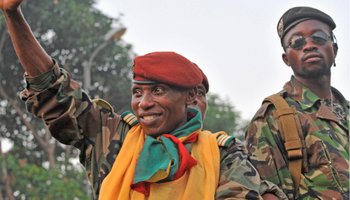 Capt. Moussa Camara, who seized power of Guinea late last year, has
promised elections and a review of the old regime's economic concessions.
Capt. Moussa Camara, who seized power of Guinea late last year, has
promised elections and a review of the old regime's economic concessions.
After a military coup in Guinea in December, the United States, European countries, the Economic
Community of West African States and the African Union condemned the arbitrary seizure of power.
But within Guinea itself, the coup led by Capt. Moussa Camara, a French-educated soldier, drew
widespread support.
"The public was reacting to 24 years of dictatorial rule, with elections in between simply a
facade for clinging to power," Sidya Toure, a former Guinean prime minister who heads the
United Republican Front party, said in an telephone interview from the Guinean capital of Conakry.
Mr. Toure resigned his office in 1999, saying the government of Lansana Conte had failed to
address corruption. Mr. Conte died in December after 24 years in power.
"Africans most always react positively to coups carried out against autocratic regimes, only
to be disappointed later with soldier rule," said Chris Fomunyoh of the National Democratic
Institute, a group affiliated with the U.S. Democratic Party that sponsors democracy promotion
efforts abroad.
Joseph Sala, a former State Department official on Africa, said a coup in Mauritania earlier last
year provoked a similar reaction - international condemnation despite widespread domestic support.
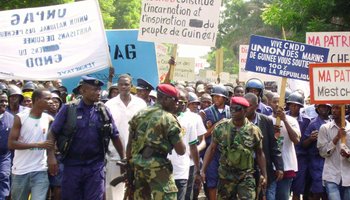 Thousands of supporters of Guinea's recently installed junta take to the
streets of Conakry to protest economic sanctions imposed on the West African country.
Thousands of supporters of Guinea's recently installed junta take to the
streets of Conakry to protest economic sanctions imposed on the West African country.
Mr. Conte's dictatorial rule was preceded by another autocratic regime, that of Ahmed Sekou Toure
(no relation to the former prime minister), who died in office in 1984.
Furthermore, Guinea was burdened in the 1990s by wars in neighboring Liberia and Sierra Leone.
Charges of systemic corruption compounded public dissatisfaction and contributed to its readiness to
give soldiers a chance to turn things around, given their promise of early elections and civilian
rule.
"The public's support should be taken as a limited approval - no more than 12 months,"
Mr. Toure said.
The country has been saddled with dictatorial rule since independence in 1958, when Sekou Toure
became the only French colony leader to reject French President Charles de Gaulle's offer of
independence in exchange for continued association with France.
As a result, Guinea was cast adrift by Paris. Sekou Toure aligned the country with the Soviet Union
and ruled until his death in 1984. The pro-Western Mr. Conte led a military government that took
over.
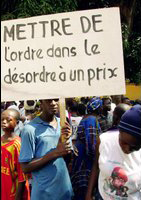 A protester in Guinea's capital, Conakry, carries a sign reading "To put
order in disorder has a price."
A protester in Guinea's capital, Conakry, carries a sign reading "To put
order in disorder has a price."
The move subverted the constitutional order, which called for the president of the National
Assembly, Abubacar Somare, to succeed to the highest office.
In one of Capt. Camara's first acts, he called senior officers, all beholden to the old regime, to
a meeting and fired them.
He promised early elections and announced that the old regime's economic concessions will come
under review.
"This country needs help from the International Monetary Fund. Merely censuring Guinea by
Western nations will do nothing to help its starved economy," Mr. Toure said. The decision to
review all concessions looks certain to cause apprehension abroad. Guinea is a prime source of the
world's bauxite and it is rich in other minerals and tropical products.
Mr. Sala, the former U.S. diplomat, said the Camara government has surrounded itself with Western
economists and financiers, who are looking at the mining and telecommunications sectors.
Mr. Toure said he will be a candidate for president during the forthcoming election, expected to
take place next year.
The former prime minister is part Malinke (Mandinka) and part Soussou, two prominent ethnic groups
that formed medieval era kingdoms in the region.
The two groups make up about half of Guinea's population of nearly 10 million.
© The Washington Times
|