|
Obama's Speech In Ghana: Notes For Nigeria
Nigeria Village Square
July 12, 2009
by Reuben Abati
Listen to the
full audio
Read
the Transcript of the Speech by the President to the Ghanaian Parliament at the
Accra International Conference Center (Accra, Ghana)
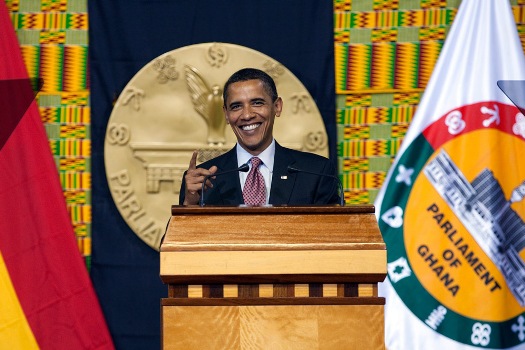
Yesterday was a good day for Ghana. It couldn't have been better. US President
Barrack Obama stood before the Ghanaian parliament and spoke for 33 minutes,
drawing rapturous applause, and we, Nigerians at home and in diaspora, were
reduced to mere spectators of Ghana's progress and achievement. Ghana was
President Obama's choice for his "first visit to sub-saharan Africa as President
of the United States" . In a speech laden with intimacy and a personal tone in
which Obama referred to his African ancestry, and Africa's colonial past, he was
full of praise for the progress that Ghana has made as an independent nation.
"The 21st century will be shaped by what happens not just in Rome or Moscow, or
Washington, but by what happens in Accra as well." And I wondered: if Ghana will
be shaping events in the 21st century, where will Nigeria be? President Obama
further told the Ghanaians: "Here in Ghana, you show us a face of Africa that is
too often overlooked by a world that sees only tragedy or the need for charity.
The people of Ghana have worked hard to put democracy on a firmer footing, with
peaceful transfers of power even in the wake of closely contested elections. And
with improved governance and an emerging civil society, Ghana's economy has
shown impressive rates of growth. This progress may lack the drama of the 20th
century's liberation struggles, but make no mistake: it will ultimately be more
significant."
I tried to relate these same words to the Nigerian experience with democracy and
economic development and I felt ashamed. What face of Africa does Nigeria show
to the world? Obama was frank and honest, and the fact that his speech was meant
to showcase Ghana, to the discomfiture, if possible, of less successful African
countries is contained in the following words: "...we must first recognize a
fundamental truth that you have given life to in Ghana: development depends upon
good governance. That is the ingredient which has been missing in far too many
places, for far too long. That is the change that can unlock Africa's potential.
And that is a responsibility that can only be met by Africans." These words need
to be carefully underlined. For as President Obama praised Ghana, he was equally
unsparing in his criticism of the many African nations that have been overtaken
by greed, failure of leadership, tyranny, and fixations with the past. He
demonstrated a close familiarity with the continent of his ancestors and he
wasted no time in reminding his audience that his grandfather was called "boy"
by the colonial masters whom he served as cook and his father was a goat-herder
who later went to school.
But he commented very early on a convenient excuse often tendered by failed
African nations, namely that the West is to be blamed for the continent's
failures. "It is easy to point fingers, and to pin the blame for these problems
on others. Yes, a colonial map that made little sense bred conflict, and the
West has often approached Africa as a patron, rather than a partner. But the
West is not responsible for the destruction of the Zimbabwean economy over the
last decade, or wars in which children are enlisted as combatants." I share
these same sentiments. Blaming the outsider, decades after independence, cannot
solve Africa's problems. Africa remains a bad tale because of the failure of its
leadership elite. Obama identified a few of the problems including "corruption
(which) is a fact of daily life for many"; and he added: "no country is going to
create wealth if its leaders exploit the economy to enrich themselves, or police
can be bought off by drug traffickers. No business wants to invest in a place
where the government skims 20 per cent off the top, or head of the port
authority is corrupt. No person wants to live in a society where the rule of law
gives way to the rule of brutality and bribery. That is not democracy, that is
tyranny, and now is the time for it to end."
Candidly, as Obama uttered these words of admonition, I concluded that someone
must have been briefing him about Nigeria or perhaps he was describing his
native Kenya. President Obama was the rich cousin speaking down on his poor
cousins and asking them to get their acts together, and we all stared, soaking
in every word. There was an evangelical flavour to his speech ("Yes, You Can" -
he told us) but he managed to pull it all off nicely because he was telling the
truth, and he had a common touch, and before him was a captive audience. It was
a singularly historic moment, occurring in the year of Kwame Nkrumah's 100th
birthday anniversary. But Obama says "Africa doesn't need strong men, it needs
strong institutions". Besides, "Africa's future is up to Africans".
Perhaps exactly what we need is a man like Obama in whose veins the African blood
runs, to tell us such home truths, in a continent that is also his own home. The
reduction of Nigeria to a spectator-nation in West Africa despite our
much-vaunted leadership in the region (population, land mass, military might,
generosity towards neighbours etc) is especially sad. At a time the Ghanaians
are enjoying prime time attention, Nigeria is in a lurch. Did you not see how
the BBC and the CNN set aside every other programme to air the Obama speech
(despite regrets about technical difficulties with the transmission- a
confirmation of the African stereotype - what do you expect from Africa?), and
how repeatedly, the Ghanaian national Kente colour was showcased on the screen?
Obama's picture was even draped with the Kente. What more re-branding does Ghana
need? The word out there, from L'‡quila to Cape Cod to Mexico is that Ghana is
one African country that works. Even if Obama visits Nigeria at a future date,
or President Yar'çdua gets invited to Washington DC, the effect cannot be the
same. So, yesterday, in concrete terms, Nigeria received a strong wake up call.
At the end of his presentation, President Obama stepped down from the stage and
was shown working the crowd in classic Clintonian style, pumping hands, slapping
backs and smiling as he moved from one African brother to another.
I took in the scene, full of envy, and I chuckled. Obama must know that he if he
had chosen to visit Nigeria, the hands he will be required to shake in Nigeria's
National Assembly will be hands that have snatched ballot boxes, hands that have
collected bribes, hands that have been used to sabotage the common good, hands
that have been used to promote conflict and misgovernance, hands that have taken
loans from banks and have refused to pay back. That the outstretched hands of
Nigeria have been rejected by the Americans is perfectly understandable. To
parody Obama, the fundamental truth that we have given life to in Nigeria is
that development does not depend upon good governance, and that leaders need not
be responsible to the people. Unlike the Ghanaians, we cannot organise good
elections. And oil which is the mainstay of our economy and which had always
given us an advantage, is in trouble. We cannot boast of impressive rates of
growth. Nigeria's crude oil production is down by 30 per cent. EquitorialGuinea
and Angola are producing more oil. Ghana has also discovered crude oil in
commercial quantities! America's CIA headquarters in Africa is in Accra. Other
African countries think that Nigeria is unnecessarily pompous. Strategically,
Nigeria has lost its edge. But if the truth must be told, Nigerians can take
solace in the fact that there are crooks in the US parliament also and that
corruption is also thriving in the United States. Afterall, the US only recently
produced Bernard L. Madoff, the biggest crook in human history! So, what was Mr
Obama's evangelism all about?
But the key emphasis to be taken away from the Obama speech is his Afro-optimism,
his conviction that transformational change is achievable in the entire African
continent, not in Ghana alone, and that the seeds for such transformation
already exists among ordinary people and in civil society. He promises America's
partnership, but he talks more about mutual responsibility. I agree with him:
Africa must play its part and desist from aid-dependence. In many ways, Obama's
speech in Ghana reflected his earlier statements on Africa except that on
policy-related issues, he was rather general and vague, and not specific on the
details of America's proposed commitments. The four areas that he has identified
as critical to Africa's future and the future of the developing world are
however apposite: "democracy, opportunity, health, and the peaceful resolution
of conflict." They are issues to which Nigerian leaders must be attentive.
He says for example that "...each nation gives life to democracy in its own way,
and in line with its own traditions, But history offers a clear verdict:
governments that respect the will of their own people are more prosperous, more
stable, and more successful than governments that do not." Hear. Hear. But
listen to this: "America will not seek to impose any system of government on any
other nation - the essential truth of democracy is that each nation determines
its own destiny." Phrased in this manner, there is a bit of contradiction in Mr
Obama's proposition. Is it actually true that America does not seek to impose
any system of government on any other nation? So what is America doing in Iraq?
Why is America at logger heads with Fidel Castro's Cuba? And why is Chavez, a
persona non grata in Washington? Why has America refused to recognise Hamas
which won a popular election? So why is he not in Nigeria? Obama condemns
tyranny in Africa but the US is friendly with Pakistan which is run by tyrants.
Nonetheless, African leaders must carefully interpret the message that America's
offer of assistance to Africa will be predicated on evidence of good governance.
"People everywhere should have the right to start a business or get an education
without paying a bribe. We have a responsibility to support those who act
responsibly and to isolate those who don't, and that is exactly what America
will do." In addition to this carrot and stick diplomacy, President Obama is
promising support for "development that provides opportunity for more people".
"By cutting costs that go to Western consultants and administration, we will put
more resources in the hands of those who need it, while training people to do
more for themselves". Thank you, sir. But I do not quite trust your statement
about agriculture in Africa. Where is the market abroad, even in the United
States, for African farm produce given the imbalance in WTO arrangements which
favour the developed countries of the North to the disadvantage of the South?
"Wealthy nations must open our doors to goods and services from Africa in a
meaningful way." Mr. Obama, how?
On climate change, Mr Obama's definition of Western responsibility is in order,
but are other members of the world's rich club willing and ready to fulfil their
promises, and respect their commitments? On the challenge of communicable
diseases in Africa, Mr Obama speaks more firmly, and it is here for the first
time in the speech that Nigeria shows up by way of reference: "Across Africa, we
see examples of people tackling these problems. In Nigeria, an interfaith effort
of Christians and Muslims has set an example of cooperation to confront
malaria." Well? The United States, says Obama, is willing to support such
programmes as well as the eradication of polio, neglected tropical diseases, and
invest in public health systems with as much as $63 billion which has already
been committed. My view is that Africans will expect even a lot more from their
brother in the White House.
The speech further focussed on conflicts - "a millstone around Africa's neck".
But it is again, Ghana that gets praised "for helping to point the way forward."
But make no mistake: Nigeria has spent a lot more on peacekeeping in Africa than
any other African nation, even if it is unable to keep the peace in its own
home. Obama says "Ghanaians should take pride in your contributions to
peacekeeping from Congo to Liberia to Lebanon..." To tell the truth, the
leadership in this regard is Nigeria's. But it is good to see that the United
States is willing to do a lot more to support peacekeeping efforts in Africa for
hitherto, Africa had been treated rather shabbily in this wise. And we note the
following declaration by the American President too: "And let me be clear: our
Africa Command is focused not on establishing a foothold in the continent, but
on confronting these common challenges to advance the security of America,
Africa and the world". Our response: we hope so.
The speech was brought to a close on a note of Afro-optimism: "With strong
institutions and a strong will, I know that Africans can live their dreams in
Nairobi and Lagos, in Kigali and Kinsasha; in Harare and right here in Accra".
Second reference to Nigeria in the speech: see - it is not possible to ignore us
completely! And does that make anyone happy? They need us- make no mistake about
that. Finally, Obama challenges ordinary Africans to be more pro-active, "to
hold your leaders accountable and to build institutions that serve the
people.... but these things can only be done if you take responsibility for your
future." Yes. But it is his own example that should in many ways inspire many
Africans in search of a better future. If it is possible for Obama, the grandson
of a cook, and son of a goat-herder turned academic to return to the land of his
forefathers as he did, then every African child must see the possibility of the
future that he talked about yesterday. Obama and his wife Michelle and their
children, Malia and Sasha later visited the Cape Coast slave Castle: a fitting
reminder of their African-American linkages, if not for Obama, at least for
Michelle and the children.
© Nigeria Village Square
|