|
Eden Newspaper Interview with Dr. Christophen Fomunyoh
Limb� - Cameroun
February 19, 2009
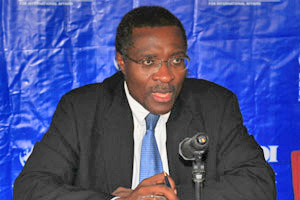
A Senior Associate for Africa and Regional Director of the National Democratic Institute for
International Affairs (NDI), a Washington-based non-profit organisation, working for the promotion
and strengthening of democratic institutions worldwide, Cameroonian-born Dr Chris Fomunyoh has said
Anglophones must shed off the victim mentality and stop complaining about marginalisation in
appointments. Dr Chris adviced that instead of complaining, Anglophones should organise themselves
and demand the right to be in position to make those appointments. “Why lament the size of
your piece of cake when the constitution allows you the right to have the cake and the knife and
decide the distribution?” he questioned.
He made these statements in an exclusive interview he granted Eden’s Publisher /Editor
-in-Chief Zachee Nzoh Ngandembou during a working trip to Cameroon in support of democratisation
efforts in a number of African Countries including Cote Ivoire, Guinea Conakry and Nigeria.
He also said that Cameroon’s lack of leadership in the Sub-region is partly responsible for
the poor economic and political transformation in the sub region.
Dr Chris Fomunyuh equally called on ELECAM authorities to demonstrate moral and political neutrality
in the discharge of their functions.
Eden: Why the surprise visit to Cameroon, and to Eden newspaper?
Dr. Chris Fomunyoh: Thanks for welcoming me to your head offices. I have been on a
working trip in support of democratisation efforts in a number of African countries, including Cote
d’ Ivoire, Guinea Conakry and Nigeria, and I thought it important to come home and spend the
national youth day 11 February, as a mark of solidarity with the Cameroonian youth. There’s no
better time to feel the pulse of the country than when our young men and women are supposed to be at
the center of discourse and future, forward looking political thinking and participation; so I could
not miss this opportunity to be home and to interact with as many of our youth as possible.
I have also followed closely the efforts of your newspaper in helping raise citizen awareness
through efficient and professional journalism, and felt obliged to come compliment you and your team
for your efforts, given the media’s vital role in every democratic society.
So, do political developments in the countries you just visited give you hope or despair
with regards to democratisation on the continent and the future of young Africans?
The democratisation process in Africa has been a multifaceted process with several success stories
such as Ghana, Benin, Botswana, Cape Verde, Mali, Mauritius and South Africa, but also persistent
challenges and set backs in places like Guinea Conakry, the Horn of Africa, and many of the
countries in the Central Africa region.
Today, unfortunately Guinea Conakry is struggling to recover from a military coup after 50 years of
autocratic rule, first under Sekou Toure and then General Lansana Conte, Cote d’Ivoire is in a
transition that needs to reunify the country after armed conflict, and Nigeria succeeded in its
transition from military to civilian rule, but still struggles with the legacy of corrupt practices
and failed elections in 2007. In those countries where democracy hasn’t taken root, and
where bad governance is the order of the day, youth are reckless, criminal activity is high and
conflict looms in the horizon, as the future seems to hold no valuable prospects for them. The
high levels of youth unemployment need to be reversed so our youth can have hope in the future and a
stake in the society of today.
The National Democratic Institute for International Affairs (NDI) where you work was at one
time, in the early 90s to be precise, an audible voice in the democratic process in Cameroon. That
voice seems to have diminished when many expected it to be louder. What has silenced it?
NDI remains a viable voice for democracy and good governance in Africa and other parts of the
world. We have programmes ongoing in at least 60 countries around the world, and our principal
approach is to work side by side with democrats in these countries who aspire to be governed
differently, as well as with governments, legislators and political and civic leaders who are
committed to putting in place processes and systems that foster transparency, accountability, good
governance and equitable management of resources to benefit citizens.
As an organisation that provides technical assistance to nascent or fledging democracies or plays a
facilitating role in political development, there is a lot that NDI could do in Cameroon under the
right circumstances; however, as we all know so well, inasmuch as ‘you can take a horse to the
stream, you can’t force it drink.’
Has NDI compromised its democratic principles and the aspirations of millions of
Cameroonians yearning for genuine democracy with covert, if not overt, support for the Biya
regime? If not, why has NDI not reacted in the face of what has been described as the current rape
on democracy in Cameroon?
Even if I would prefer a different metaphor to describe the state of democracy and good governance
in Cameroon today, I would admit that our country is far from meeting the expectations and
aspirations of millions of our fellow country men and women. I sense a certain restiveness in the
air. Since the first mutliparty elections in 1992, the conduct of elections have become increasingly
contentious and the recent accusations and counter -accusations on ELECAM do not augur well for
greater participation and more credible polls anytime soon; political parties are weak and very
fragmented; most political decisions are made by decree with little or no opportunities for citizen
input; very few channels exist for alternative view points to be heard and incorporated into policy
making; and the legislative branch of government has not shown particular effectiveness in
exercising its oversight functions over the Executive branch.
I fully understand the yearning for genuine democracy among fellow Cameroonians because they look
at various African countries doing well, many of which do not have as much human and material
resources as does Cameroon, and wonder why not our own country. Why are we so far behind when
those other countries are doing well? Why is political discourse so sterile or polarized in
our own country, and when will we ever get ahead or be given a high seat at the table of democratic
nations?
Unfortunately, NDI cannot respond in place of the Biya government, but these are very
legitimate questions for which those in power today owe Cameroonians responsible answers.
NDI’s sole mandate is to support and promote democracy worldwide, and the Institute would
never be complacent with a government that suppresses the aspirations of its people — au
contraire!
Generally, NDI issues statements on countries in which we have ongoing programmes or where we
conduct assessment missions, which has not been the case for Cameroon since 1992.
Nevertheless, the Institute’s report of 1992 raised many concerns and made several
recommendations which are still valid today. I may also add that several other democracy
support organisations have made critical assessments of the state of governance in our country, and
today’s leaders ought to heed the genuine advise that is being provided.
How would you assess the following projects and processes in Cameroon: good governance
programme, democratic process, the fight against endemic corruption, NEO (National Elections
Observatory)?
I couldn’t in good conscience rate government performance in these areas too favorably, but
more than my personal assessment, we should all be concerned about what the ordinary Cameroonian
thinks. How he or she feels about their well-being, and whether they think their lives are
better off today than was the case a decade or two ago; and whether they are optimistic about the
future of the country.
We should be encouraging think tanks, civil society organisations, and media houses to conduct
public opinion polls and to make their findings public so those that govern can get an idea of how
their performance is graded or judged by the people they are supposed to serve. This is
happening more frequently across the continent, and I hope we can find effective ways to gather and
publicise citizens’ opinion on the issues that we as Cameroonians care the most about.
Perhaps constant and public ratings by citizens would jolt the government into better performance.
Considering the inherent weaknesses in the ELECAM law, its organisation and the recent
partisan composition of its appointees, do you see that body putting an end to the recurrent
history of election malpractices in Cameroon?
There in no denying that the birth of ELECAM has been surrounded by extraordinary discord among
Cameroonians over its composition and its ability to deliver a credible electoral process. In
politics, perceptions are as important as the reality. Also, we have to keep in mind that
electoral bodies like ELECAM or Independent Elections Commissions are not credible solely because
they have been decreed as impartial; rather such bodies are credible because the electorate, and the
public as a whole, view or perceive them as such.
Where the trust and full confidence of the public is questionable from inception, as has been the
case with ELECAM, extraordinary steps would have to be taken by members of ELECAM to demonstrate to
millions of Cameroonians that they are deserving of respect for their moral probity and political
neutrality. Without such extraordinary steps or measures, I am afraid that millions of
Cameroonians would be quick to conclude, unfortunately, that credible elections and the possibility
of a peaceful change of power through the ballot box are very unlikely in our country.
Another aspect of your work involves high level negotiations with government leaders on
governance issues, which some have described as a form of non governmental statecraft or
diplomacy. Some critics have repeatedly decried what has been described as Cameroon’s
timid diplomacy. Do you accept this view?
I have heard, and indeed do share that criticism. Our country has so much to offer Africa and
the world, and I wonder why we sell ourselves so short. Look at the intellect and dynamism of
our people, look at the Cameroonians who are succeeding on their own in various international
organizations, think of our bilingualism and the possible appeal to Anglophone and francophone
countries and cultures, factor in the diversity of our religious affiliations and our inherent
ability to relate to Christian and Islamic countries, look at even our geographic location on the
map of Africa and gulf of Guinea. Why we can’t leverage all of these assets in our
diplomatic outreach is beyond my understanding.
Many countries today even project their diplomacy and public image by participating in
international peacekeeping missions. How many of such missions is our country involved in,
and wouldn’t that be one way of enhancing the professionalism of our military and security
services, and projecting a better image for ourselves and our country around the globe?
Cameroon has so much to offer, and through our diplomacy we could project ourselves effectively in
the international arena. Many of our diplomats are yearning for opportunities to serve their
country diligently without us having to spend huge sums paying lobbyists and public relations
experts from Europe and Western capitals, as is currently the case.
Our tiny neighbours of Gabon, Equatorial Guinea and to some extent Congo Brazzaville have
continued to poke Cameroon’s eye. What policy approaches would you recommend to deal
with them?
Today, each of Africa’s sub regional entities has a natural lead country. South Africa
plays that role in the Southern Africa sub region just as Nigeria plays it in West Africa, and Kenya
does same in East Africa. Many Africans expected Cameroon to step forward and play that role
in the Central Africa sub region. Helas that is not happening, and because power abhors a
vacuum, other neighboring countries have tried to rush to the rescue from time to time. Surely
this competition for sub regional leadership which would naturally be Cameroon’s explains why
our region is unable to experience the kind of economic and political transformation that other
parts of the continent have enjoyed.
Many private investors remember the split between Cameroon and Gabon over the regional stock
exchange. What happened to Air CEMAC and other regional initiatives that have remained on
shelves and in file cabinets? It seems to me that our sub region has the highest concentration
of natural resources per capita in Africa, but lacks far behind in both economic development and
democratic governance. There has not been a peaceful transfer of political leadership in this
sub region for the longest time. In this modern day and age, a country can only lead by
example, and the big question remains whether Cameroon would someday take and show the lead in this
part of the continent.
There is a growing school of thought that there should be a paradigm shift in our foreign
and economic policy focus-from the Central African Sub regional grouping of ECCAS to ECOWAS, given
the fact that the latter is more competitive, economically viable and diplo-politically stronger.
Do you agree?
Surely, ‘if wishes were horses, beggars would ride.’ The people may wish they
were part of ECOWAS, but governments make these decisions, and there’s no reason to believe
that the government of the day would want to subject itself to the growing competitive standards of
state behavior within ECOWAS. Also, lest we forget, belonging to an organisation does not
necessarily guarantee proper behavior on the parts of governments.
Zimbabwe belonged to the Commonwealth until recently, and yet that had no impact on how the leaders
there governed. One must admit that despite the historic ties that bound our people, for a
long time, we have tended to look at our Nigerian neigbors to the West with less openness than we
have treated our Gabonese or Congolese neigbors to the East. Hopefully, the peaceful
resolution of the Bakassi border dispute between Cameroon and Nigeria may usher in a new era of
intensified and constructive political and economic cooperation for the benefit of peoples on both
sides of the borders.
Could this be explained by the fact that Gabon and Congo are French speaking countries
whereas Nigeria is an English-speaking country? Along those lines, do you believe there is
an Anglophone problem in Cameroon? And if yes, what should be done to solve it?
Obviously some of those post-colonial bonds die hard, but I also would say that Cameroon’s
relations with China for example have nothing to do with the ability of our leaders to speak
Chinese. So, ultimately, it comes down to the vision that political leadership projects for
its people. That’s one of many reasons why it is extremely important to frequently renew
political leadership in every country so new leaders can bring a fresh perspective to global trends
and developments, and help move their countries in ways that may differ from previously long held
typical and traditional approaches.
The French themselves have huge investments and more vested interests in Nigeria than they do in
all of francophone Africa, so why would we pretend to be ‘holier than the Pope’?
The world is changing fast, and we need to move our country along rather quickly for the betterment
of our people. I have spoken extensively on the anglophone problem in the past. I
believe there is an anglophone problem in our country; I also believe, very strongly, that it
can be solved and will have to be solved.
Why in your view do you think the Francophone leadership since independence, has refused to
acknowledge what Anglophones see as marginalization?
I would not generalise the myopism to francophone leadership alone, because some Anglophones would
tell you there is no Anglophones problem in Cameroon. Many Francophones, including some in the
media, have been very vocal in raising public awareness on Anglophone grievances. While the
marginalisation may exist to some extent, we Anglophones are also going to have to shed off the
victim mentality.
We have to stop complaining about not having an Anglophone appointed minister of defense or
minister of finance, or director general of SONARA or SNH as I have read in some papers lately;
rather, we should organize ourselves and demand the right to be in a position to make those
appointments. Why lament the size of your piece of the cake when the constitution allows you
the right to have the cake and the knife and decide the distribution?
Are you saying that an Anglophone could become President of Cameroon one day?
Of course, yes! And many Francophones have told me they wish the same for the future benefit
and stability of our dear country. Go back to the results of the 1992 presidential
elections. The Anglophone candidate Ni John Fru Ndi’s highest vote percentage was not in
an Anglophone province - in fact he scored highest in the West, North West, Littoral and South West
provinces in that order.
Since 1992, the number of Francophones who have become bilingual and therefore more likely to be
comfortable with an Anglophone candidate has increased tremendously. Check the statistics in
Universities in Britain, Canada, the United States and South Africa, as well as efforts at bilingual
education in secondary and high schools around the country.
And I am confident that an Anglophone will be President someday, not because he or she speaks
English, but because he or she is qualified and competent, and will be judged by the content of his
or her character and the vision that such an individual projects for our country and its
people. I can cite over a dozen Anglophone Cameroonians who match these criteria, and who
would lead and represent this country in ways better than anything we have seen in the last five
decades.
Cameroon, like much of Africa, suffers from excessive brain drain. Why would Dr. Chris
Fomunyoh not come back to Cameroon and contribute his quota in the development process?
You ask a pertinent question, and the brain drain from Africa is something the continent must
address. In many ways though, I do not consider myself part of the brain drain because my job
for the last 16 years has been focused exclusively on Africa and its quest for democratic
governance. I could be based in Yaounde, Maroua or Limbe and still be doing what I have done
across the continent for close to two decades.
So, I feel very fortunate to be working on these issues that impact directly on the lives of fellow
Africans. I am also very thankful to the thousands of other African brethens with whom we
continue to chart this course, and to the millions more who are part of the new wave of a more
democratic Africa. Perhaps someday, like every bird that must perch, I would focus on
deepening the democratic tenets in this triangle of my own country, Cameroon. The elders of my
native area of Moghamo always remind me never to be like ‘the shoe mender who walked
barefooted.’ Even that generation of Cameroonians understands our country needs a
democratic boost; and doesn’t the Bible say there is time for everything?
Of late, you have become a very regular guest to the Francophone and French media and the
French top brass! How should we interpret this?
Well, that should be interpreted as an ordinary African from Cameroon eager to explain
developments in his part of the world so as to raise awareness on the successes as well as the
plight of his people. From my frequent travels and interactions, I see a growing openness in
Western capitals including Paris, London, Brussels and Washington to have Africans take charge of
their destiny.
The media, opinion and policy makers are eager to engage with Africans of good will who have the
commitment and wherewithal to contribute to positive change on the continent. The global
trends are lining up for Africa, including our own country Cameroon, and it is for us to stand up
and be counted. I would speak to the Chinese and South Korean or Spanish media if that would
enhance the cause of democracy and good governance on our dear continent. Africa and Cameroon
deserve no less.
Interviewed by Zachee Nzoh-Ngandembou
� 2009 Eden Newspaper
Article copied from © ICIcemac.com
|