|
Gerontocracy in Cameroon - These Old Men Who Govern Us
By Dibussi Tande
March 03, 2009
“It is extremely important to frequently renew political
leadership in every country so new leaders can bring a fresh perspective to global trends and
developments, and help move their countries in ways that may differ from previously long held
typical and traditional approaches.”
Dr. Christopher Fomunyoh
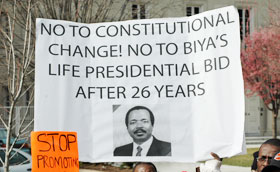 Last February 13, President Paul Biya of Cameroon
celebrated his 76th birthday. This septuagenarian, who has been Cameroon’s president for the
last for 27 years, is the leader of a gerontocracy which has ruled the country for half a century
– old men and women way past their prime but desperately clinging on to power. The result?
Cameroon is increasingly looking like the pre-Gorbachev Soviet Union, whose entire leadership was
made up of the infirm, senile and “walking dead” of the Politburo. Last February 13, President Paul Biya of Cameroon
celebrated his 76th birthday. This septuagenarian, who has been Cameroon’s president for the
last for 27 years, is the leader of a gerontocracy which has ruled the country for half a century
– old men and women way past their prime but desperately clinging on to power. The result?
Cameroon is increasingly looking like the pre-Gorbachev Soviet Union, whose entire leadership was
made up of the infirm, senile and “walking dead” of the Politburo.
In June 2008, the French language monthly La Cité revealed that 80% of
Cameroon’s ruling class consisted of individuals who were way past the official retirement
age, and that 80% of the 34 new ambassadors appointed that year were also above retirement age. In
fact, some were actually pulled out of retirement – this, in a country where life expectancy is about 52 years.
La Cité also profiled 60 key members of the ruling elite, who by virtue of their
age, should have long retired and given way to a much younger generation of leaders. Here is a
snapshot of that list:
Armed forces
- Major General Pierre Semengue, 73 years old (first indigenous head of the armed forces in 1960)
- General Asso’o Emane Benoit, 71
- General Rene Claude Meka - army chief of staff - 70
- General Mambou Deffo, 70
- General Camille Nkoa Atenga, 70
Public Corporations
- Felix Sabal Lecco - President, National Council of Communication, 90+ years (joined the Ahidjo
government in 1969; minister of Justice in 1970)
- El Hadj Ousman Mey - Chairman, National Social Insurance Fund, 83+ years (founding member of
Ahidjo’s Union Camerounaise in 1958; Federal Inspector/Governor of North province from
1960-1983)
- Simon Achidi Achu – Chairman, National Investment Corporation (SNI), 76 years (First
appointed minister in the Ahidjo regime in 1970; Prime Minister under Biya from 1992 - 1996)
- Adolphe Moudiki – Director General National Hydrocarbons Corporation (SNH), 70 years, (the
“young” Moudiki first became a government minister “only” in 1987)
State Institutions
- Cavaye Yegue Djibril - President of the National Assembly, 70 years
- Paul Pondi - President of the Civil Aviation Authority - 80+ years (First Cameroonian head of
National Security in 1960)
- Paul Tessa – President of the Anti-corruption commission (CONAC), 70 years (First became a
government minister in 1972)
- Jean-Baptiste Beleoken – Director of the Civil Cabinet at the Presidency, 76 years (Was
the commercial adviser in the Cameroon embassy in Paris in 1961, and ambassador to the Soviet
Union in 1973)
- Martin Belinga Eboutou – Adviser to the President of the Republic, 70 years (former
ambassador to the United Nations, his first key position in the foreign service was as the Charge
d'Affaires in Cameroon's Embassy in Brazzaville, Congo in 1970)
Roving Ambassadors
- Jean Keutcha, 85+ years (Secretary of State for Public Works in 1964; Minister of Foreign
Affairs in 1971);
- Marcel Medjo Akono, 84+ years (First appointed a provincial governor in 1972)
- Joseph Charles Doumba, 72 (First became a government minister in 1972)
This is merely the tip of the iceberg; septuagenarians and octogenarians still occupy key positions
at all levels of the public service, public corporations, the police and armed forces, effectively
preventing the much needed and long overdue renewal of state institutions. In the process, an entire
generation of young Cameroonians has been permanently sidelined, unlikely to even manage,
govern or lead in their lifetime. As La Cité laments,
Au Cameroun, des dinosaures de 1960, sont toujours en fonction, pendant que leurs petits-fils
sont en quête d'un premier emploi / In Cameroon, the dinosaurs of 1960 are still in
office, while their grand children are still searching for their first employment.
Once a Nation of Young Leaders…
“I want to express, on behalf of all of us, our great pleasure in having the President of
the Cameroon visit us, and the members of his Cabinet. The President is the second youngest
President in the world… The President here is 36-7 and feels that those older than that
should step aside!” President John F. Kennedy, March 13, 1962
Cameroon was not always a gerontocracy. In fact, most of the individuals who now control the levers
of power in the country started off very young. For example, 80 year-old Ferdinand Oyono, who was
still a cabinet minister in 2006 and still wields immense power as an unofficial adviser to the
President, was Cameroon’s representative at the United Nations in 1960 when he was just 31
years old, i.e., before the current US President Barack Obama was born.
Ahmadou Ahidjo became President of the Republic of Cameroun at 36; Paul Biya was 34 years old when
he was appointed Director of the Civil Cabinet at the Presidency in 1967 (with the rank of
Minister), 42 years when he became Prime Minister in 1975, and 49 when he succeeded Ahidjo as
President of the Republic; General Pierre Semengue, was a very young 25-year old Captain when he
became head of Cameroon’s armed forces in 1960.
And the list goes on…
Joseph Owona became director of the International Relations Institute of Cameroon (IRIC) in 1976,
"when he was all of thirty-one years old" (Martin Mayer, The Diplomats, p. 162);
Bello Bouba Maigari became Paul Biya’s Prime Minister in 1982 at 35; Dorothy Njeuma, who
until a few weeks ago was still the Rector of the University of Yaounde I became Vice Minister of
Education in 1975 when she was 32 years old; Nzo Ekangaki was 28 years old when he became Deputy
Minister of Foreign Affairs in 1962, and 38 when he was elected Secretary General of the
Organization of African Unity (OAU); Paul Bamela Engo, currently a judge at the International
Tribunal of the Law of the Sea, was 33 years old when he became a Minister Counselor at the Cameroon
Embassy in Bonn, Germany in 1964 and 38 when he was elevated to the rank of a Minister
Plenipotentiary in 1969, Kamdem Niyim became Minister of Health in 1964 at the age of 23, etc., etc.
Lack of Renewal (political sclerosis, economic stagnation and insecurity)
The inability or unwillingness of Cameroon’s ruling class to renew and reinvigorate its ranks
with young blood has led to a political sclerosis that is evident in an over centralized political
system which is out of step with the exigencies of a modern 21st century state particularly with
regards to democracy, basic human rights, the rule of law and good governance. The old methods of
the one-party era still hold sway in spite of the much touted "political liberalisation".
This is also evident in inward-looking and discredited policies from a different age that have no
place in today’s global village, and are out of sync with the knowledge economy and
technology that drive globalization. To Cameroon’s gerontocracy, globalization is not
about becoming a credible competitor on the African or global market place but about importing cheap
products from China or Europe or giving the Chinese and others sovereignty over Cameroonian waters and fertile lands to use as
they see fit.
And, the idea that Information and Communication Technologies (ICTs) can actually be harnessed for
purposes of national development is considered a far-fetched one, in spite of regular conferences
about the value of “les NTIC’ to Cameroon’s development. Thus, no effort is being
made to create a technical and legal framework for e-commerce, and the notion of e-government is
limited to creating rarely updated and websites ministries and public corporations.
Any wonder, therefore, why the government would require that the thousands of individuals who want
register for the entrance examination into the national police academy travel to Yaounde (sometimes
for as long as two days) just to personally drop their applications at the school when these applications
could simply have been sent electronically from any internet café in the country?
And no one has yet figured out that ICTs present a way out to the overcrowded and overburdened
higher education system…
Even the armed forces apparatus is a victim of an aging leadership which has been completely
overwhelmed by today’s security and military challenges, from the proliferation of arms and
armed gangs in the central African region and the resultant insecurity on Cameroon’s borders;
rise of “grand banditisme” within the country, with last year’s attack on banks in
Limbe being one of the most glaring examples; piracy in the oil-rich Gulf of Guinea and armed
insurgency on the Bakassi peninsular, etc. Young officers, many of whom are graduates of top
military institutions such as West Point, are sidelined by the old generals who studied at Saint-Cyr (Generals Semengue, Meka, Youmba, Mpay, Tchemo) or elsewhere in the
1950s and 60s and who are versed in conventional WWII-type warfare which is of little relevance in
dealing with today’s challenges. Even the armed forces handbook, the top secret doctrine
d'emploi des forces camerounaises, has apparently not been revised since 1980. The results are there for all to
see...
End Note
I am in no way claiming that Septuagenarians and even octogenarians cannot contribute to
national development or that they are unable to lead simply because of their age. Far from it. I am
referring specifically to the Cameroonian case where a gerontocracy, which as been in power since
independence, has abdicated its leadership role, has lost all interest in innovation and
modernization to the extent of becoming an obstacle to development, and is more interested in
accumulating wealth and devising creative strategies for hanging onto power at all cost.
In a recent interview with Eden Newspaper, Chris Fomunyoh of NDI explained why leadership renewal is
critical:
“It is extremely important to frequently renew political leadership in every country so new
leaders can bring a fresh perspective to global trends and developments, and help move their
countries in ways that may differ from previously long held typical and traditional
approaches.”
Cameroon has, unfortunately, not learned this lesson. The result, as we have seen, is political
sclerosis, economic stagnation and rising insecurity within the country and at its borders. Today,
Cameroon’s gerontocracy has not just sidelined an entire generation of active Cameroonians
willing and able to contribute their quota to national development, but is dragging the country back
into the 19th century. Making the leap back into the 21st may soon become a virtually impossible
task if nothing is done to rectify the situation.
© Dibussi.com
|