|
Election run-off keeps Ghana on democratic track:
analysts
AFP Global Edition
December 12, 2008
by Susan Njanji
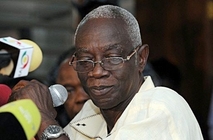
AFP/File - Chairman of the electoral commission Dr. Kwadwo Afari-Gyan announces
the final results of the presidential . ACCRA (AFP) - Ghana faces a tense runoff election to find a new president, but
most analysts say the failure of either of the frontrunners to win in the first
round may be good for the African nation.
Nana Akufo-Addo of the ruling New Patriotic Party (NPP) won 49.1 percent of the
vote in last Sunday's first vote, ahead of John Atta-Mills of the opposition
National Democratic Congress (NDC) with 47.9 percent, according to the electoral
commission.
Both parties had high expectations going into the vote and in a country that
experienced many coups in the years before its return to democracy in 1992, a
second round will help let off political steam, analysts said.
"It's good for Ghana that we will have a run-off to ease the tension, it
does not mean that the campaign towards a run-off is going to be any easier or
more peaceful than it was the first time, its open-ended, it could be quite
rough as the candidates finish hard," said Emmanuel Akwetay, executive
director of the Institute of Democratic Governance (IDEG), a non-government
group.
"For peace activists the run-off was the dream outcome because the
presidential contest had been fought vigorously," he added.
The NDC won most seats in the parliamentary contest, held the same day for which
results were announced Thursday. Results from 229 of the 230 constituencies show
the opposition secured 113 against the ruling party's 109, down from 128 in the
old parliament. The rest went to minority parties and independents.
If Akufo-Addo wins, it will be the first time in Ghana since 1992 that a head of
state has to deal with an opposition-dominated parliament.
Akufo-Addo admitted Wednesday that the next president would have to "work in
a consensual manner with this new parliament".
He highlighted his skills as a former diplomat and foreign minister who had
brought warring factions together in various countries.
Nana Oye Lithur, head of the Ghana-based African office of the Commonwealth Human
Rights Initiative, said a run-off could act as shock absorber given the
confidence the two parties built ahead of the results announcement.
"It is good because it's a divided country, and with a second round, a
defeat will not be as devastating and as dramatic as in the first round,"
said Lithur.
Chris Fomunyoh of the Washington-based National Democratic Institute (NDI) said
given the closeness of the vote, Ghana stands to gain from a second round of
voting.
"An election this close shows a country politically split almost down the
middle," he said.
"A second round will produce a clear cut winner with a mandate to govern and
legitimacy that would not be contested for the next four years," he said.
Ruling NPP chairman Jake Obetsebi-Lamptey agreed that a run-off would have a
calming effect. "The opposition had been heightening tension over the first
round, they have been crying from the very beginning, that this was going would
be a Zimbabwe/Kenya affair if they were not declared winners."
Ghana could provide the shining Africa needs after the crises that followed
elections in Zimbabwe and Kenya this year, analysts said.
© Yahoo.com
|