|
Conflict Prevention and Resolution Forum
Achieving Peaceful Elections: Lessons Learned from Sierra
Leone and Nigeria
October 9, 2007
Speakers:
Christopher Fomunyoh, Senior Associate for Africa, Regional
Director for Central and West Africa, National Democratic Institute (NDI)
Christian Hennemeyer, Director of Programs for Africa,
International Foundation for Election Systems (EFES)
Moderator: Randolph Carter, Program Manager,
Children and Youth Division, Search for Common Ground (SFCG)
Looking back at the recent elections in Sierra Leone and Nigeria, the October
forum examined and illuminated the nexus between elections and conflict. The
significance of fair and transparent democratic elections was highlighted, but
it was stated that democratic elections should not be confused with sustainable
peace, democracy or even governance. Elections were characterized as a
possibility of a change, a process that in some cases solidifies peace, and in
some other stirs up preexisting tensions. In addition, the highest degree of
importance was ascribed to the work before the elections - among other,
preparation of legal framework and support to develop the infrastructure of the
civil society. In this context, the remarkable work of Search for Common Ground
(SFCG) in the Sierra Leonean elections was offered as an example of successful
cooperation with local actors in making the process transparent and credible.
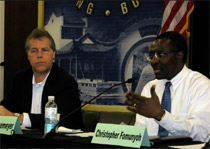 In the
introduction to his presentation, Dr. Christopher Fomunyoh mentioned the eof an
ongoing public debate abothe relation between elections and conflict - he
pointed out that the elections are said to have a role ineither generating or
mitigating conflict. However, in Dr. Fomunyoh's words, while it is common
knowledge that democracy is necessary for sustainable peace, it is clear that
democratic elections alone do not bring about peace. Democratic elections, Dr.
Fomunyoh said, can either help support the peace process, or generate upheaval.
They usually bring to the surface preexisting elements of conflict and expose
them to the public and the international attention. In addition, in an ideal
case, elections are supposed to bring about a peaceful allocation of power.
According to Dr. Fomunyoh, the problem is not with elections as such, but with
flawed elections. He added that elections can be a tool for conflict mitigation
and resolution, as well as a sort of a "rites of passage" for parties
to resolve conflict among themselves. Some of the more successful election
processes in Africa, according to Dr.
xistence
ut
Fomunyoh, paved the way for democratic gains. Furthermore, elections can also
help in or bring about fostering of multi-ethnic collaborative relationships and
networking across ethnic lines. In Dr. Fomunyoh's words, ethnic affiliations are
what elites have relied on, whereas elections can foster networking across the
ethnic channels. In both countries, Dr. Fomunyoh continued, politicians at the
last election seem to have had non-ethnic bases of support. In the
introduction to his presentation, Dr. Christopher Fomunyoh mentioned the eof an
ongoing public debate abothe relation between elections and conflict - he
pointed out that the elections are said to have a role ineither generating or
mitigating conflict. However, in Dr. Fomunyoh's words, while it is common
knowledge that democracy is necessary for sustainable peace, it is clear that
democratic elections alone do not bring about peace. Democratic elections, Dr.
Fomunyoh said, can either help support the peace process, or generate upheaval.
They usually bring to the surface preexisting elements of conflict and expose
them to the public and the international attention. In addition, in an ideal
case, elections are supposed to bring about a peaceful allocation of power.
According to Dr. Fomunyoh, the problem is not with elections as such, but with
flawed elections. He added that elections can be a tool for conflict mitigation
and resolution, as well as a sort of a "rites of passage" for parties
to resolve conflict among themselves. Some of the more successful election
processes in Africa, according to Dr.
xistence
ut
Fomunyoh, paved the way for democratic gains. Furthermore, elections can also
help in or bring about fostering of multi-ethnic collaborative relationships and
networking across ethnic lines. In Dr. Fomunyoh's words, ethnic affiliations are
what elites have relied on, whereas elections can foster networking across the
ethnic channels. In both countries, Dr. Fomunyoh continued, politicians at the
last election seem to have had non-ethnic bases of support.
Dr. Fomunyoh also spoke about other manifestations related to the election
process: the fact that the abilities of the civil society become visible, as
well as the notion that governments can achieve legitimacy in the course of
peaceful and democratic elections. In Dr. Fomunyoh's words, the reverse happened
in Nigeria - the president inherited power after flawed elections. This is
primarily the reason why the new president lacks legitimacy, even though for
many Nigerians he seems like a promising choice.
The comparison between Sierra Leone and Nigeria, Dr. Fomunyoh stated, looks at an
odd couple. Sierra Leone, he added, is a small country with few resources and a
high level of political will to do the right thing. Nigeria, on the contrary, is
a country with huge resources and an atmosphere of general indifference to
democratic elections. In addition, Dr. Fomunyoh said that in Sierra Leone the
elections were being monitored by an independent commission, while in Nigeria
many important elements were missing. One of these was limited media coverage
with only a few media houses present, another was the unwillingness of the
election commission to do the right thing.
Christian Hennemeyer started his presentation by saying that IFES had worked in
Nigeria since 1998 with the government and the NGO community on restructuring
the election commission and the voter registration commission. Echoing Dr.
Fomunyoh, Mr Hennemeyer said that the comparison between the two countries is
indeed not an easy one. In his words, the elections in Sierra Leone are by far a
more positive example but also not without problems. Another issue, Mr.
Hennemeyer mentioned, is that the election is not the only way to measure
democracy. Democracy can be good and stable even with bad elections. After all,
in Mr. Hennemeyer's words, both countries will be judged by how well the
election is going to be transferred to services delivered to their respective
populations.
Mr. Hennemeyer pointed out that the preparation of elections represents the
"real work" behind the election. What this means, he added, is that,
in years before the election, election law is being reformed or designed,
electoral managing body is being structured or restructured, a system for the
registration of voters is being set up. In Mr. Hennemeyer's words, voter
registration in Nigeria was disastrous this time, while Sierra Leone did a very
good job and showed high level of accuracy in registering voters. In Nigeria, he
further stated, wide spread inaccuracies occurred partly due to logistical
challenges but mostly it was fraud that caused these. Some of the
manifestations, in Mr. Hennemeyer's words, were erroneous tallies, underage
voters, falsified voter registrations and more than 100% voter turnout. The
difference between Sierra Leone and Nigeria as regards voter turnout, according
to Mr. Hennemeyer, was mainly in dealing with such erroneous data - in Sierra
Leone such results were immediately cancelled. In the case of Nigeria, he added,
the country has a way of dealing with voter fraud, but it may take 2 or 3 years
before we see the election results overturned.
An additional factor, according to Mr. Hennemeyer, is that the fresh memory of
war seems to have played a role in the Sierra Leonean elections - people were
aware of the alternative and were thus more determined to have real democratic
elections.
In terms of management bodies, Mr. Hennemeyer said, there is a large difference
between the two countries. He continued by saying that since Sierra Leone is a
small country, its management body with one chairperson and four commissioners
fits its size. In Nigeria they have one chairperson, twenty two commissioners,
37 state commissioners and thousands of people on the payroll.
Additional factors are, according to Mr. Hennemeyer, the fact that the staff in
Sierra Leone was young and new, the chairperson an "outsider" a nun
named Christina Thorpe. Both she and her Nigerian colleague Dr. Ewu were
election outsiders, which, Mr. Hennemeyer commented, meant that their careers
were not put at stake. In his words, having "amateurs" as heads of the
managing body usually leads to "decent" election results. In Nigeria,
however, Mr. Hennemeyer added, this was not the case. One of the problems he
pointed out was that Dr. Ewu and others had received a lot of pressure from the
executive mansion.
Mr. Hennemeyer also brought up the EU final report on the Nigerian election
process. The report, he said, points out the structural flaws, some of which are
the widespread irregularities and voter disenfranchisement. The report's
conclusion, he quoted, described the process as having fallen short of standards
and therefore ultimately not credible. To this harsh criticism of INEC, Mr.
Hennemeyer added, the Nigerian government reacted by criticizing the report for
being biased.
In addition Mr. Hennemeyer reiterated that the differences between the two
countries played a role: the small size of the country and the centralized
system in Sierra Leone, versus the huge size of Nigeria with its strong
executive playing a dominant role.
"Having said all this," Mr. Hennemeyer added, "we must emphasize
that elections alone are not a measurement of democracy." He mentioned
other tools to measure democracy, such as the media, judiciary, civil society or
anti-corruption bodies. In Nigeria, Mr. Hennemeyer further stated, the media are
much more sophisticated, while the judiciary is perhaps not always objective,
but also not always predictable. According to him, the civil society is
prominent in both countries. Regarding the anti-corruption bodies, Mr.
Hennemeyer limited his comments to mentioning that the EFCC is a new body and
for the first time in history one authorized to put in people in jail for
corruption.
Finalizing his presentation, Mr. Hennemeyer asked himself and the audience the
following question: "What do we learn form these lessons?" People in
Nigeria, he added, admit the process was flawed, but believe the outcome was
still the best possible one. "Is the process important?" he asked,
immediately replying that it certainly is. The examples discussed here, Mr.
Hennemeyer stated, also show that election law is critical. In Nigeria, he
added, the President had inordinate power and the INEC was directly financially
dependant on the government which in turn was very negligent with funding. In
Mr. Hennemeyer's words, the election law should have made INEC a truly
independent body. According to him, press controls were also critical in this
case. In the context of ethnicity signs were appearing that divisions were
breaking down. In regard to other democratic institutions, he added, it should
be highlighted that the cycle is much longer - although donors get excited about
elections because they are a process with measurable results, with a beginning
and an end, working together with the civil society, the judiciary and all those
who contribute to the election process is crucial. All the agents, Mr.
Hennemeyer pointed out, should be supported to help make the process free, fair
and transparent. He concluded by stating that elections should not be confused
with governance.
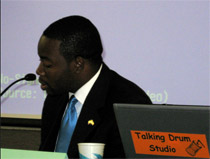 Two members of the SFCG staff spoke about the outstanding work of the
organization in the preparation and realization of the Sierra Leonean elections.
Randolph Carter pointed out that, in Sierra Leone, SFCG focused on building
capacity and establishing local structures that support a credible free outcome
in elections. In this framework, SFCG supported an extensive national veducation
campaign. Furthethe organization coordinated andirected the development of
thIndependent Radio Network (IRNas well as the National Election Watch (NEW), a
coalition of civil society organizations dedicated to observing the elections.
Philip Hellmich talked about two concrete activities of SFCG on Election Day:
deploying 420election reporters in partnership with IRN, and supporting NEW's
6,000 domestic observers. (For more information see
oter
rmore,
d
e
),
www.sfcg.org - West Africa Update) Finally, Mr. Hellmich highlighted the
importance of the media for democratic and credible elections, stressing itnot
just in the coverage, but also in the preparation of the process. The real
challenge, he statis how to keep this infrastructure alive.
Two members of the SFCG staff spoke about the outstanding work of the
organization in the preparation and realization of the Sierra Leonean elections.
Randolph Carter pointed out that, in Sierra Leone, SFCG focused on building
capacity and establishing local structures that support a credible free outcome
in elections. In this framework, SFCG supported an extensive national veducation
campaign. Furthethe organization coordinated andirected the development of
thIndependent Radio Network (IRNas well as the National Election Watch (NEW), a
coalition of civil society organizations dedicated to observing the elections.
Philip Hellmich talked about two concrete activities of SFCG on Election Day:
deploying 420election reporters in partnership with IRN, and supporting NEW's
6,000 domestic observers. (For more information see
oter
rmore,
d
e
),
www.sfcg.org - West Africa Update) Finally, Mr. Hellmich highlighted the
importance of the media for democratic and credible elections, stressing itnot
just in the coverage, but also in the preparation of the process. The real
challenge, he statis how to keep this infrastructure alive.
Audio recording of this forum [mp3] 
©
SFCG.org [pdf]
|